I finally found my fifth moon of Jupiter! It's called Himalia, and lives about a degree away from Jupiter in the sky. We recently opened our observatory to the public for three nights, and had clear skies for the last two. After the last people left the dome and were chatting downstairs I set to work obtaining more images of the star field near Jupiter. Unfortunately my Canon 1000D had had a slight mechanical problem, resulting in a brush hair being trapped in front of the sensor. The shutter open-close mechanism suddenly failed to move faster than 1/200" and I tried to clean it with a substandard optical brush. The calibration is a little out. The flat field needs to be updated and also the dark frames I used were from a warmer night. Depsite this, stacking 8 x 30" pictures gave me this interesting image, showing rays of light radiating from Jupiter...and a teency, tiny little dot that was not on the Palomar Observatory Sky Survey red plates. This is Himalia, an outer rock orbiting Jupiter way beyond the four big, bright Galilean satellites that were viewed by many folk earlier in the evening. Some of the visitors got a preview of Himalia on the back of my camera after I had tried to get a few early shots of it. The event was a great success, thanks to the weather holding out and our facilities having been well maintained.
Sunday, 13 January 2013
Tuesday, 1 January 2013
A glimpse into Orion's depths.
At last! A snippet of clear sky between fast-changing clouds. Enough to grab a few 30 second exposures of a weird little nebula, IC 426. I turned to one of my to do lists on my phone, that contained unusual objects I wanted to image. I managed to get a moment after a short viewing session at the observatory to whack on my camera, focus on Alnilam, and run off some shots as I dodged the clouds. The moon was rising during the exposures, of which 12 were useful. I got home and processed in Deep Sky Stacker, using some old darks and flats, which I really need to update. Still I got this weird blue thing that looks a bit like the North America Nebula. All I saw on the back of the camera was a wavy line passing between the two brightish stars at centre and winding round like a river on a map. After processing, the rest of the nebula appeared, along with a few other patches. Judging from the colour, this looks like a reflection nebula. The nebula is located to the 'upper left' of the star Alnilam, and the orientation of the illumination seems to fit with Alnilam being the source. So as a first guess, this floating patch of dust could be part of the Orion Stellar Association about 900 light years away [need references].
Thursday, 22 November 2012
The lunar city?
Well as usual in the British Isles, it has been cloudy. Very cloudy. Especially when the moon is out of the way. Anyway, I haven't blogged for a while, and was browsing some videos I recently took with the ImagingSource video camera, attached to the Celestron 9.25" Schmidt-Cassegrain telescope. I turned from Jupiter to the Moon on the 2nd November and found some beautifully interesting areas. I recorded 30 seconds of video around the rather disturbed 'square' area close to crater Aristarchus near the left edge of the moon. Oceanus Procellarum is to the bottom. In this image, with the sun high above the lunar surface, the terrain has a darker, browner appearance than the surrounding land and the brightness of Aristarchus really stands out. With Vallis Schröteri running across the square and various rilles and ridges in it, the area gives the impression of a city. Straight lines appear to fly around the whole image like jet contrails. Moving to the upper right from the volcanic looking Aristarchus, you come to the strange arc shaped feature Prinz, then Montes Harbinger. These mountains border the lunar sea Mare Imbrium. The video was selected, stacked and sharpened in Registax 6.
Saturday, 20 October 2012
Cygnus supernova remnant
I finally got all 6 of my pics of different parts of this supernova remnant processed, including the flat field calibration frames I took during the following session at the observatory. This has really helped me tease out the faint filamentary details. The pictures are aligned but not spaced as they appear on the sky, so you don't have to pan around to see the detail. The real object covers a rather large patch of sky in Cygnus and is visible through an ultra-high contrast nebula filter in most telescopes from a dark site. They are reduced to 25% size here. Each picture is a whole bunch of 30 second exposures at f/3 using my modified Canon 1000D on the society's 20" telescope.
Sunday, 16 September 2012
A new astrophotography challenge
Taken through the 20 inch scope, the ISS (space station) passed first 350 miles from the observatory, then went round the earth and passed 1000 miles from the observatory then faded into the earth's shadow (night). I had to chase it, but I got pics both times round with my Canon. I made them into this mosaic that puts the images much closer together The second time round (bottom), it was at a lower altitude in the sky. It moves at something like 20000 mph! I'm well chuffed just seeing some detail. I guessed an exposure of 1/800" at ISO 1600. Apparently the software we have can be programmed for tracking satellites. Next time the ISS shows its face in the evening, I'd like to give imaging it a proper go. The tracking accuracy involved in getting the ISS on our Imaging source camera's tiny chip with a barlow lens might well out stretch our capabilities.
Season two of the galaxies
In autumn, our planet's orbit takes us into such a position that looking away from the sun is out of the plane of the Milky Way. Spring is the best galaxy season, but season 2 of the galaxies is autumn, when we look out toward the galactic south. The milky way appears to roll around from South-North to East-West for northern hemisphere observers. In this vast blackness, in the constellation Pegasus are galaxies NGC 7479 and NGC 7814. The former is located below the bottom right star of the Square of Pegasus and the latter just inside the Square's lower left corner star. 7479 has amazingly wide spiral arms, and 7814 is as exact and edge on view as I've seen, but it was not possible to see the division visually in the 20" scope. For 7479 I stacked 35 30 second shots and for 7814 I stacked 14.
Palomar 8
Palomar 8 is a globular cluster orbiting our galaxy that we see as its passing through the galactic plane. This means it has lots of dust in the way and consequently its light is quite attenuated. I was browsing through Sagittarius with the 20" telescope and just hopped a bit to the left of open cluster M25 and got a few images of this faint globular.
Wednesday, 22 August 2012
Perseid!
Ka-pow! Another piece of space flotsam slams into the upper atmosphere at supersonic speed. This one, a remnant of comet 109P Swift-Tuttle encounters us at something like 58 kilometers per second. I had left the camera continuously exposing Saturday night, and the following Tuesday after Andy had set his DSLR going I had another crack of the whip. 13 second exposures seemed about right. I got lucky. Soon after starting I caught a Perseid meteor shooting through Cassiopeia, then I got even luckier with this substantial one. However I missed seeing it due to my strange posture while setting up the camera. I had just repositioned it on the ground and clicked the remote. After a few seconds, Andy exclaimed something and my shutter closed. He had seen it while looking about 90 degrees away - so it must have been pretty bright. The first I knew of it was the strange little white line that had appeared on the preview screen. It looks like it's slamming into the top of the tree and the glow from Norwich seems to add an aesthetically nice balance to the photo. Here is the single 13 second shot, with no processing.
Sunday, 19 August 2012
Our overlooked neighbour
When I say 'neighbour' here I mean JUST 3 million light years away. Our 20" telscope has had some structural work done and we're in the process of tweaking it. I had some success with it last night but I might have reassembled my focal reducer lenses wrong as there was more coma than usual. Also I couldn't test the optics well as the mirror had become hot during the day and was cooling and also the seeing was poor for a while. I got some lovely pics of M31 (our nearest big neighbour galaxy) and M57 (the ring nebula) as well as one of a comet in Bootes. It was all going well until the house down the road switched its outdoor light on floodlighting the observatory for about 2 hours! I had to turn the dome away from them. So I got this nice picture of M33 with 1 minute exposures at f/3. You can see the collosal nebula NGC 604 to the left, and NGC 595 above the centre. What a pretty object, although of course it is an immense collection of objects.
Wednesday, 25 July 2012
A new surge of astronomical activity across the UK
What with the consistent beautiful clear weather we've had following months of persitent rain and cloud, the guaranteed clear skies have brought everyone out to look at the stars. I've spent many a moment staring up at the Milky Way on recent nights. You can follow it from Sagittarius and the Scutum cloud in the South, to the fork at Aquila the eagle, up through the Cygnus rift, where the swan flies along it from right to left, and across the gap to Cassiopeia, the 'W' in the North East. The double cluster is visible in the space between Cassiopeia and Perseus, who is climbing up from the North East horizon. Below Cassiopeia, the Andromeda galaxy is now visible again. When I look at this galaxy, I try to imagine it far beyond as well as below our Milky Way Galaxy above it. Of course, the true scale is unimaginable. This photo is of a fairly large patch of sky in Cepheus (the King), situated just above the Milky Way inbetween Cassiopeia and Cygnus. I centred on the nebulosity illuminated by the red star mu Cephei, called the 'Garnet Star'. Delta Cephei, the archetype Cepheid variable is visible to the lower left, also with what looks like some nebulosity near it. Some call it the Elephant Trunk nebula, but I guess I'd have to get a little more zoomed in. It's a stunning wide field with dark dust lanes strung out in front of the background stars in the next outer spiral arm of our Galaxy. Picture comprises of 9 x 1 minute exposures through a 135mm lens stopped to f/4, tracked on an EQ5 mount, and many flats and darks were taken to calibrate the picture.
Monday, 23 July 2012
At last... a clear night!
I had to take the opportunity of a clear night to get a picture of this lovely object with my little 8" Schmidt Cassegrain Telescope. The Society's 20" newtonian is undergoing a hardware upgrade at the moment, and besides this huge nebula won't fit into it's field of view. I went back to doing what I used to do, find a dark field, as far from light pollution as I could. My telescope's (Meade LX10) Right Ascension motor was tracking well now due to a replacement Tantalum bead capacitor on the PCB and I had previously calibrated it to sidereal tracking rate by following a star and adjusting a replacement potentiometer. I went near Seething, an old hamlet and airfield near where Norwich Astronomical Society's observatory is based. I was (and still am) horrified by the brightness of a glaring blue white light in the middle of the rural darkness. The people who install these lights must have no awareness. Anyway, I carefully aligned my tripod, which gave me good tracking for 30 seconds, despite the gentle breeze. Focused on Antares, and got a few test shots while darkness was falling. I captured 50 or so frames of this obejct, the Lagoon nebula, M8 on my modified Canon EOS 1000D, attached to the 8" SCT via an f/6.3 focal reducer. I also got all the calibration frames, Flat-field frames were obtained rather crudely in the field, using a mobile phone to illuminate an A3 sheet of paper held in front of the scope. It's probably best to use twilight next time as they weren't brilliant, but did the job. So here you go, my first picture for a long while on my good old 8" SCT.
Sunday, 15 July 2012
Grazing occultation of Jupiter
We were due, at shortly after 3 am Sunday July 15 for the moon to pass over half of the planet Jupiter. This view was only visible in a short band across the UK, with our observatory smack bang in the centre. I stuck it out at the observatory. It had clouded over yet again. I was watching the satellite picture. Andy came over, not wanting to miss anything, but it started to rain, on and off. The situation didn't look good. After Andy's departure and a further hour, the clouds started to part in the West and in a bright sky I found stars to focus the scope on. I attached the Canon and eventually the tiny break passed over the moon, and I focused. A slightly bigger break revealed bright Jupiter, just off the moon. So I missed it, but saw a beautiful conjunction in the morning sky. I got two shots to make this mosaic. It's amazing how fast the moon moves. Brilliant Venus poked out shortly thereafter, and I watched them all the way home, rising into the ever brightening dawn twilight.
Friday, 13 July 2012
Wolf 359
I was recently reminded of the song Far Out by Blur in which the star Wolf 359 is mentioned. I remembered that I had located it and taken a shot recently on a solo astrophotography trip to the observatory. It is about 13th magnitude and can be found in the South of Leo. The star itself is a red dwarf, a little bigger than Jupiter, you can see the deep orangey red colour to it in this photo. But more significantly, it is one of the closest stars to our Sun at 7.8 light years away and so its motion causes it to drift across the sky from year to year (~5"). Here, it is moving from top to bottom and slightly to the right, so it will pass close to the star beneath it in the coming few months. A background galaxy (14.5m) can be seen to the lower left, and an even fainter one (17m) above the arrow (Magnitudes found using Aladin).
Monday, 25 June 2012
The Noctilucent Clouds are back!
Hurrah! I get a lovely feeling when these return. It's almost like the Gods are happy. I didn't see any last year, which is unusual for a night owl like me. This was a pretty display blocked somewhat by some lower cloud drifting past the northern horizon. I stepped out of my urban abode after midnight last night (June 25) to check out the twilight in the north, and saw a wispy glow. I put something warm on and drove out just north of the city with a camera and tripod and took a few shots. I could see an intense but small column to the NNE, that dissipated slightly just before the tripod was up. This shot was 5 seconds at ISO 800. I could also see Saturn and Spica setting in the south west over the airport, and Sagittarius in the south, with a hint of Milky Way running upwards into the Summer Triangle. I popped out at 2:30 to see a much brighter display in the stronger twilight where wave structure was very evident. Doing a bit of cloudbusting, it looked like three symbols, with the first one a 'Y'.
Thursday, 7 June 2012
Venus in transit
Tuesday, 5 June 2012
Venus approaches transit
Tuesday, 29 May 2012
El Sol, le soleil, die Sonne, the sun, yr haul.
On a sunny saturday afternoon Andy SMSed me about doing a bit of solar astronomy. We got down the observatory and I got the 20" on Venus and the Coronado SolarMAX onto the bright object you see above. With DSLRs we adjusted the focus, filter tilt, and exposure to get several pics that were subsequently stacked using Registax. I've put the earth to scale, which reminds me there's the Venus transit at dawn on the 6th of June... of course Venus will be closer than the Sun so appears as an almost arc minute sized disc. Venus is now rapidly approaching the sun in our skies and I wait in anticipation, hoping for clear skies.
Monday, 21 May 2012
Black Hole Jet
For the first time, I've imaged a jet from a supermassive black hole. This one lies at the centre of the elliptical galaxy M87 in Virgo. It is an active galactic nucleus, which means the black hole is swallowing stuff. Big stuff, like vast clouds of interstellar gas, dust and whole stars! The black hole spits the material out again as jets that shoot out of the galaxy for thousands of light years. This one is tens of millions of light years away from us. I heard a recent talk at our society by a guy who was into quasars, and it made me wonder if I could get a picture of this relatively close by jet. I was told to use short exposures to avoid over exposing the bright core of the galaxy, so I used 10 seconds at f/3 on the 20 inch with my good old Canon 350D. I used the best 26 pics and used 40 darks. In hindsight I could have upped the exposure a little. I applied some old flat fields later and tweaked it a little. The pic at the top shows a close up of the nucleus and jet, which in true astronomical fashion, appear as little fuzzy blobs. At least this fuzzy blob is more of a fuzzy streak, but it's such an amazing thing to visualise it from such a distance. I've also uploaded the original size field where you can see a few more small members of the Virgo cluster.
Labels:
AGN,
black hole,
galactic nucleus,
jet,
M87,
supermassive black hole,
Virgo cluster.
Sunday, 6 May 2012
Integral sign
Friday, 27 April 2012
Amazing conjunction!
This would be an impossible conjunction, mainly because of the fact that the bluish star, zeta Boötis is out of the plane of the Solar system. Also, the brightness of Mars and the star is a bit fainter than that of Venus. All these were taken on the evening of Thursday 26th April using the Imaging Source DBK camera with a 2x barlow lens on the Celestron 9.25 inch SCT. Mars was particularly sharp, even at a scale of about 0.25 arc seconds per pixel, as it was nice and high in the sky. Zeta Boötis is a double star challenge, I wanted to see if I could visibly separate two stars less than 1 arc second apart. Given Mars is about 10 arc seconds across, I think I can see a fainter star, just above the main bright one. It's not clear or fully seperated but elongated slightly at what looks like a Position Angle of about 350º. Is this right? I think I had the camera orientated correctly so top is approximately North. I'm now going to check it out, and see how wrong I am (I'm trying to be scientific and not biased about it). Anyway enjoy the lovely composition!
Update on z Boo: I was wrong. It turned out I'd tried to detrail the star a little, just 1 or 2 pixels, but the trail was in fact the pair, and they were equal in brightness on a East West alignment. So I had (unscientifically) assumed my raw data was in need of a correction, and in so doing, hid the possible detection of the second star! It is apparently only 0.5" away. Here's the original pic.
The edges of the lunar landscape
Here, we are peering slightly around the north east (top right) side of the moon, due to it's slightly wobbly path around us here on Earth. This libration effect has made the lunar sea Mare Humboldtianum visible behind the crater Endymion. The slight fuzziness of the image is because the jet stream was over us again, which resulted in not so good seeing conditions. Also I was looking through a fairly large air mass. It was taken with the society's Imaging Source DBK camera using a 2x barlow lens, on a Celestron 9.25". I tilted the camera and overlaid two images that were quite close. Each image was a composite of several hundred movie frames, stacked in Registax 5.1. For fun (heh, geek fun) I also made a colour version, where I corrected the colour cast, blurred the hue channel and ramped up the saturation.
Sunday, 8 April 2012
Ring galaxy
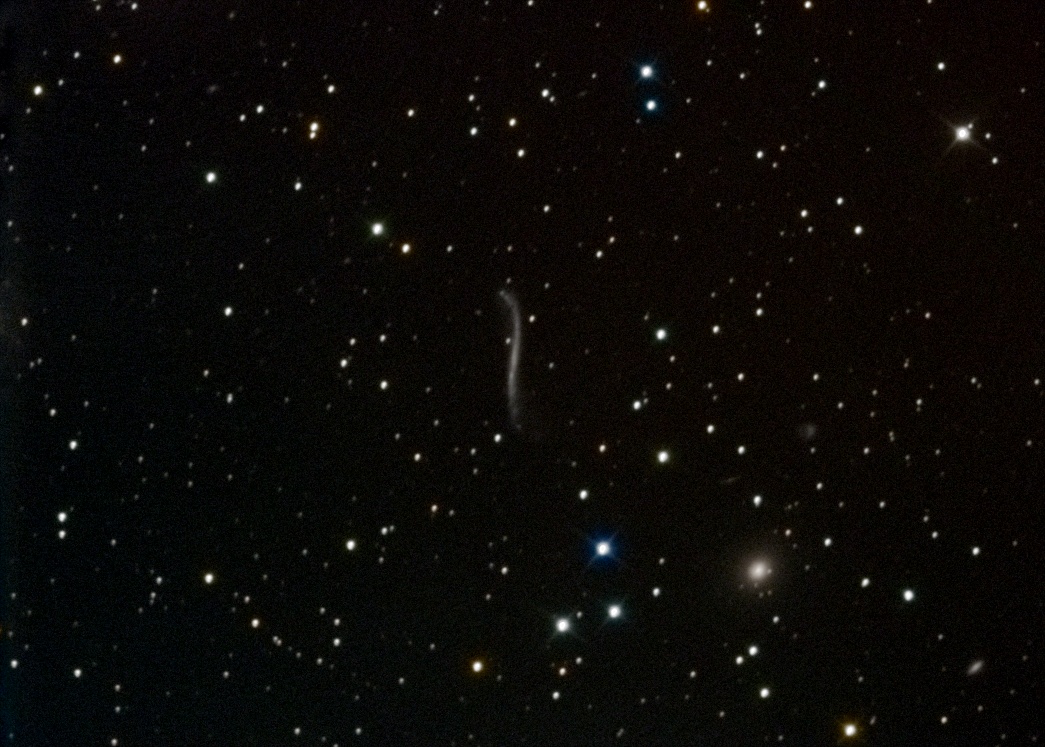
Now here's a far away thing. NGC 5701. I heard this 'little' thing had a detached ring around it so I thought I'd add it to my itenerary one night imaging at the observatory. I got 13 pics of 30 seconds each at f/3 on the 20", and appropriate darks. I later applied some previously taken flats, which haven't done a perfect job. You can see a couple of dust doughnuts as I've had to ramp up the contrast of the shadows to show the faint ring around this galaxy. When I first looked at the images on my camera, I was a little disappointed to see just a normal spindle-like shape, but an interesting bar across the middle nevertheless. There was no evidence of a ring among the light pollution. Even after stacking the images, it had to be teased out in the process of processing, so I'm presenting this image with camera readout stripes and 'noise' across it just so you can see this fascinating feature. The galaxy is classified as an SBOa-R (R for ring), and the central core comprises of some tightly wound spiral arms. The ring is just connected to the central part of the galaxy at one point, not easy to see in this picture. This galaxy would be an ideal candidate for the Atik when it is higher.
Thursday, 5 April 2012
CME
I popped over the obs. this afternoon and did some imaging of the sun with the Gordon-cam, a portable DBK colour camera designed to run in planetary video imaging mode. This was attached to our Coronado 40mm Solar Max Hydrogen-alpha telescope. I aimed for 1000 frames per video. For this image, I adjusted the exposure/gain to make red saturated & exposed for flares, and green nearly saturated & exposed for surface detail. Even though green should not be detecting light in H-alpha imaging there will be some transmission of red light through the green filters on the camera's sensor. Very useful - 2 exposures in 1, and a nice coloured picture. Oh and I had to de-interlace the picture and reaverage the even and odd rows, then sharpen, which could be fixed with a monochrome sensor (DMK). I just thought I'd post this as the Sun looked surprisingly detailed, with a Coronal Mass Ejection 10-15 earth diameters long. In this image, celestial north should be up, so solar north should be tilted according to the ecliptic angle of about 20 degrees clockwise. As the solar x-ray activity was low, I wasn't expecting much, and was really surprised to visually see these huge stripes across the sun, and a healthy load of flare activity around the limb.
Thursday, 29 March 2012
Mars in the galaxy den.
I'd known about this conjunction of Mars and some galaxies for a while, but I missed the close pass due to cloud and caught this wider grouping with a telephoto lens. I got 16 1 minute shots by piggybacking the camera on the society's 9" SCT, on the EQ5 mount, unguided. Unfortunately, my 400mm f/6.3 lens is a tad old and scratched and not really up to the job. But!... I've managed to get an early picture of the Supernova in M95. Pic was taken March 18th, before I'd even heard about it. I'd since seen M95 in an 8" scope at a star party and wondering whether any of those stars were supernovae. I've stuck a little postage stamp sized pic I took of M95 in 2010 next to the galaxy, just to prove it is the supernova. It's a weird picture, containing a strange, abberant and colourful reflection of Mars's light from the lens. I quite like the aesthetic effect of the extreme orange starburst around Mars. I've captured galaxies down to magnitude 14, but they are all faint smudges at best using this equipment.
Wednesday, 21 March 2012
Heavenly lights
Hello, not blogged for a while so looking through my memory stick I found this one of a recent conjunction. In this scene, the lighting of Norwich cathedral is revealed in all its heavenly glory, shining up into the heavens themselves. Viewed from St James's Hill, the Roman Catholic cathedral appears prominently to the right of the cathedral, and to the right of that the "considerately" lit Sportspark pitches. The Sportspark is not actually part of the University of East Anglia, only by location and name and hence it is not subject to any environmental considerations, just economic ones. In fact, you can't see the Sportspark, because it is over 3 miles away. The general ochre glow in this contrast-enhanced picture contrasts with the natural bluish glow of the moonlight and faint twilight. On the 26th of January 2012, when this picture was taken, Venus was graced by the presence of the crescent moon (upper right of the cathedral). The crescent cannot be discerned because of the contrast enhancement, but the Earthlight reflected back from the dark side of the moon gives a sharp circular edge to the upper left of the moon. A rather aesthetically pleasing composition captured in a few seconds.
Labels:
light pollution,
Moon.,
Norwich,
sportspark,
UEA Sportspark,
venus
Sunday, 4 March 2012
Deimos
Look what I caught the other night! A little tiny rock called Deimos, floating around Mars. I hadn't seen any pictures of this taken from earth, and didn't know whether it was possible for our home made scope. I checked it out prior to travelling down the "obs" and saw there was a faint background star. I wondered why I wasn't able to stack the images properly until I realised Mars and its little moons were being dragged across the sky too quickly. I got a second image in the video camera showing the moon had moved away from the star as predicted. You can't beat that for proof. Deimos is a dark asteroid like moon less than 10 miles across. It's like seeing a city as far away as Mars! All of this totally obscured by the glare from the planet itself. I was lucky it was between the diffraction spikes. I only saw it after averaging the photos - it is the inner dot, right of the slightly trailed dot close to Mars. I overlayed a set of 1/3200 second exposures on top of a set of 1 second exposures, at ISO 400 on the modified Canon 1000D. Right, now for Phobos - even closer. I'm really not sure that will be possible, but I'm gonna give it a shot with what I've got.
Wednesday, 29 February 2012
The Orion Nebula
Dwarfingly large billows of fluorescent hydrogen smoke glow from the intense ultraviolet radiation emitted from the stars that lie in the centre of this nebula. Blue wisps envelop the chasm that has been sculpted by their radiation pressure. Deep blue emission is caused by the atomic line of the hydrogen atom, where the electron quantum jumps between levels n=4 and n=2. On top of this, larger molecules drift and float about and reflect the bluish starlight from the central trapezium of hot stars. Among the larger molecules we call 'dust' many stars are being born. Infra red space telescopes can penetrate this dust to reveal the stars in the process of creation via nuclear ignition, driven by the gravitational collapse of leagues of dust molecules. A thousand or so years later this light hits my camera for a few minutes. Cool ... literally freezing, but with a hot centre.
Labels:
emission,
fluorescence.,
fluorescent,
hydrogen emission,
M42,
Orion nebula
Monday, 20 February 2012
Big comet floats into view
As you can see, I can't fit the 2 lovely tails of (2009 P1) Comet Garradd into the field of view of the Atik camera on the 20" scope. I limited the total exposure duration to about 7 mins, but there is still some movement of the comet. The faint fan of tails to the bottom (~west) is just visible, and the big slightly redder coloured anti tail goes up. I think it's about time I tried a picture of this on a smaller scope. This picture was taken at 23:00 on Feb 19th 2012. This comet looks set to put on a nice show for us in the northern hemisphere, as it's now up all night.Monday, 30 January 2012
Monday, 23 January 2012
Quasar madness.
This is not just an 18th magnitude dot. This 'dot' has a red shift of 3.21. That means it is currently 21.6 billion light years away, but it appears in our past 11.7 billion light years away. That's totally messed up when you can't even say how far away it is. It takes far away things to another level. It is a Quasar, a galaxy with a central super massive black hole jet pointing straight at us. I can't express how bright this thing is other than to say that it has an absolute magnitude of -30.0. OK, well I'll have a go. Hang on, I'll get my calculator out... If the quasar was at a distance of, say, the Pleiades star cluster is from Earth, it would appear nine times brighter than the Sun is to us on Earth (caveat: that's probably not an appropriate distance for the calculation). Our universe is only 13.7 billion years old and you're looking back across most of that time, to a time when not only the Earth didn't exist, but the Sun also didn't even exist!
Sunday, 15 January 2012
Mars
Mars is becoming visible again at long last! Here's a picture from the lovely clear night of Saturday 14th January 2012. Picture taken about 00:30 UT 15 Jan 2012, via a DBK colour camera taking 30 seconds worth of 30 frames per sec at 1/109 second exposure, a 2x Barlow lens, on the 20" scope, masked down to 8". 450 pictures were chosen and stacked, sharpened, and a tweak was made to the blue and green channels to compensate for the difference in focus between these colours. Well that's what I did. I'm amazed how much detail I got given the conditions and fact that Mars is tiny! It is a mere 10.2 arc seconds across, or about 180 x smaller in angular extent than the moon. It is half the diameter of earth, 4200 miles, at a distance of about 83 million miles away. You can see Syrtis Major on the left, the large Hellas basin above it, which is near the south pole. Mare Erythraeum is the dark patch at top, the light gap at top right is Chryse, followed by Mare Acidalia. The large area at centre is Arabia Terra. Below Syrtis Major, is Utopia (just at edge), Boreo Syrtis, Protonilus and then a stretching dark finger along the bottom right, Deuteronilus. The light area at bottom right is Vastitas Borealis (North at bottom).
Monday, 26 December 2011
More delights of Orion
The chocolate box of Orion contains a selection of objects from visible to photographic beauties. The area around Alnitak (ζ Orionis) is particularly striking with a good telephoto lens. This particular lens has produced a couple of new nebulae via internal starlight reflections. The spike at top left is Alnilam trying to peek into the edge of the shot. I piggybacked my modified 1000D camera on the club's 9 1/4" scope on a CG5 mount and without guiding, got some 2 minute exposures through an old f/6.3 400mm lens. The RA drive had a wobble with a 10 minute period, causing most of the pics to be slightly trailed, but I managed to stack 12 of them with a combining method that minimised trails. So, here I present 24 minutes of exposure centred on the dark cloud called the Horsehead nebula B33, which protrudes against the hydrogen-red background of IC 434. The blue reflection nebulae NGC 2023 and IC435 can be seen below the horse, shining from within the sooty cloud. The more yellow or pinkish Flame nebula, NGC 2024, appears attached to the other side of Alnitak, and this can be seen, albeit dimly, in telescopes much more easily than IC 434. The grapefruit like colour tells us that it is not exclusively shining in hydrogen red light and there must be some cosmic dust scattering component to its colour, rendering it visible to human night vision.
Labels:
B33,
Flame Nebula.,
Horsehead nebula,
IC 434,
IC435,
NGC 2023,
NGC 2024
Thursday, 22 December 2011
The Perseus Cloud
A dim patch of light emerges from the dark cloud in southern Perseus. This is NGC 1333. I thought I'd have a second try at this object with my modified camera on the 20". I had a good dark night when the object was quite high and plenty of light gathering power. It was a bit of a struggle getting good auto-guiding, as it is a dark cloud and there are not many bright stars nearby to guide on. I did a bit of masking and selectively blurring the dim nebulosity, in order to try to smooth out the background, but started to get into 8-bit processing artefacts. In the final image (33 x 30second & darks, flats, etc.), reddened stars abound in the dark cloud, and the blue reflection nebulosity fades into the darkness around the edges. A few dark lanes cross the nebula and a few spots of activity show up dotted off to one edge. The large dark cloud crosses the centre of the image and background stars appear to peek out to the right edge. The width of this picture is similar to that of the moon.
Wednesday, 21 December 2011
Breckland Skies in Winter
I love the return of these beautiful constellations on freezing cold nights. It was dropping well below freezing and as I looked south out of the dome at Breckland Astronomical Society I could see stars right down to the horizon. There was one star especially low down below the constellation Lepus, which I recognised as Pheat, from Columba the Dove. I couldn't see the other two stars near it - but I grabbed the Canon and gorilla pod and clamped it onto the edge of the dome, pointing south. I found I could fit in all of Canis Major and Orion with the standard lens set to wide. I processed to reduce a bit of the background glow, but it was much stronger towards the horizon. An odd cloud was floating through Columba, which I could see. It wasn't moving fast, and appeared pretty small, but it managed to smear out on this image. There were a few high clouds drifting by which I could only see on the photographs. The camera managed 21 good 15 second shots before the battery ran out of juice in the cold and I stacked them in Deep Sky Stacker. Hence the motion blur across the southern horizon. If you look closely you can see the red R Leporis off the upper right of the main pattern of Lepus, next to a whiter star for comparison. I have not processed to show the Rosette, Horsehead, Flame and Orion nebula.
Saturday, 3 December 2011
NGC 40
Here's a pretty little stellar remnant that's visible in average telescopes most of the year from the UK. NGC 40, which can be found in Northern Cepheus, shows up very red on film, but is blue in appearance even in large telescopes. Due to this bright redness it shows up very quickly on camera. I got a handful of pictures of 30 second duration, some 10 second and some 3 second, stacked them, then averaged and sharpened them. I think it looks quite a flowery little nebula.
Thursday, 1 December 2011
The Intergalactic Wanderer
The intergalactic wanderer (NGC 2419) is actually not wandering. It is in a 3 billion year orbit around the Milky Way, which takes it further away than the Magellanic Clouds. It's currently 275 000 ly from us and 300 000 ly from the milky way's centre. I remember reading some notes in"Cirque du Ciel" (actually Cartes du Ciel) that the individual stars are 17th magnitude. Some facts about it don't square with me. I read that this globular is huge, and compares to omega centari (see recent posts), which has millions of stars. It is intrinsically very bright in total and appears as a 9th magnitude fuzz in the scope. But the individual stars must be 17 or so magnitudes below that (because 17 magnitudes = a factor of 6.3 million in brightness), more like 26th mag. Perhaps there is a huge range of brightnesses and the brightest ones around 17th magnitude. It is a big, big thing a long, long way away in any case! I wonder if it can sense the dark matter halo? The cluster lies in the direction of Lynx, near the twin stars Castor and Pollux from our humble perspective. I did a colour blur on this image and upped the saturation, sharpened a bit to make it all pretty. I suspect the colour went a little bit crazy along the way, but I love those colourful, spiky starbursts.
Spooky, Nebulous Fingers.
WE pointed the twenty inch at the Eastern Sky, so we could get a nice long exposure without rotation. Rising nice and high is the constellation Auriga, the charioteer, and in its centre lie some interesting patches of nebulosity. The "spooky, nebulous fingers" in this photo are otherwise known as the central part of IC405. There's a nice bright guide star here for us. I got 30 minutes worth of luminance, colour and dark images, using the Atik at -20 C, binning 3x3. I stacked in MaximDL then processed by blurring the colour frames, aligning and colour combining. An auto flat overdid things, so I averaged the autoflat corrected frame with a copy of the uncorrected frame. Next, I ran Digital Development and liked the contrasty effect, so I did the same thing with this. I couldn't mamange to get bright colours, they just don't seem to be there in this object. I think nebula filters Ha OIII Hb are the way to go! I did a small manual detrail using 'layers' and 'darken' on it to get round stars. This object is also somewhere in my past blog. Hopefully this pic is an improvement.
Thursday, 24 November 2011
The Lagoon and The Trifid Nebulae
Four 5 minute exposures of a favourite region of sky of astronomers was enough to produce this wonderfully colourful and stunning scene. The Lagoon nebula (Messier 8) is below centre, and you can see red hydrogen gas extending out to the left of it. Around that is a dark, twisty channel, with some strange tight turns. That is in turn blocking out the light from the myriad stars of the central milky way in the background. A short hop celestially north lies the trifid nebula (M20), which shows its beautiful colour contrast, and the star cluster M21 appears above that. The darkness to the right is merely apparent due to the blocking of star light by tiny aggregations of molecules, spread thinly, but over such a large volume they collectively cut out virtually all what we see. Other wavelengths of radiation, such as infra red, can shine through these clouds. The 'visible' wavelengths between 0.4 and 0.7 μm were captured with a Canon 1000D with the nearIR-red filter removed, through a Sigma telephoto zoom lens at focal length ~ 300mm, on a well aligned Astrotrak.
Nebulae in Norma
When I was collecting my stellar photons from those sparkly, southern skies last summer I rushed back into my little warm chalet to process the photos. I discovered a new nebula in Norma! Well it had been there all along, but I like to think that. It's a personal discovery. It looks like a swooping giant bird. Apparently it is called NGC 6188, and there is another planetary like nebula towards its north west (upper right), which appears as a fuzzy star on my poor resolution picture. You can see zeta Scorpii at the top, along with another one of my personal discoveries, namely a big faint red patchy ring around the whole cluster. Actually come to think of it, the whole picture is teaming with my new 'personal' discoveries. Dark, straight lines. Who said nature doesn't like straight lines? a physics teacher? Well my last few years of astrophotography have shown me many rows of stars in lines that are too straight to be chance alignments. There are a sequence of giant (I mean HUGE and capitalisation of the letters really is quite an understatement), dark, frigid clouds across the picture. Also, there seems to be a tinge more redness down towards where the tree has made its impression on the moving stack of photos that went into producing this image, but that could easily be an artefact of the processing. The atmopheric extinction of starlight shows up with the lack of light pollution, at such high contrast.
The void
Sorry for not posting for a short while. I've been looking into the void. Unfortunately, I was aiming for the diffuse irregular galaxy IC 1613 in Cetus (/Pisces) and I synchronised the telescope on the wrong star. It wasn't far away, but instead I got an 11 minute picture of the star Hipparcos 5166 and the brightest object of interest in the field was a distant 16.88(blue) magnitude galaxy NPM1G+02.0042 . I haven't even heard of that catalog. I decided to look up the galaxy on deep sky browser (http://www.messier45.com/). That's what you get when you look in the wrong direction in the vastness of the cosmos. Nothing. (Well that is if you ignore all those stars).All this despite the lovely, considerate ("health and safety") lighting the neighbouring village hall provides for their car park (and the local few cubic miles of sky). I have spoken to them about this, but they are in no hurry to change or reposition the lights. What a situation for an astronomical society... when you can't control your local light pollution.
Subscribe to:
Comments (Atom)