 I'd known about this conjunction of Mars and some galaxies for a while, but I missed the close pass due to cloud and caught this wider grouping with a telephoto lens. I got 16 1 minute shots by piggybacking the camera on the society's 9" SCT, on the EQ5 mount, unguided. Unfortunately, my 400mm f/6.3 lens is a tad old and scratched and not really up to the job. But!... I've managed to get an early picture of the Supernova in M95. Pic was taken March 18th, before I'd even heard about it. I'd since seen M95 in an 8" scope at a star party and wondering whether any of those stars were supernovae. I've stuck a little postage stamp sized pic I took of M95 in 2010 next to the galaxy, just to prove it is the supernova. It's a weird picture, containing a strange, abberant and colourful reflection of Mars's light from the lens. I quite like the aesthetic effect of the extreme orange starburst around Mars. I've captured galaxies down to magnitude 14, but they are all faint smudges at best using this equipment.
Thursday, 29 March 2012
Mars in the galaxy den.
I'd known about this conjunction of Mars and some galaxies for a while, but I missed the close pass due to cloud and caught this wider grouping with a telephoto lens. I got 16 1 minute shots by piggybacking the camera on the society's 9" SCT, on the EQ5 mount, unguided. Unfortunately, my 400mm f/6.3 lens is a tad old and scratched and not really up to the job. But!... I've managed to get an early picture of the Supernova in M95. Pic was taken March 18th, before I'd even heard about it. I'd since seen M95 in an 8" scope at a star party and wondering whether any of those stars were supernovae. I've stuck a little postage stamp sized pic I took of M95 in 2010 next to the galaxy, just to prove it is the supernova. It's a weird picture, containing a strange, abberant and colourful reflection of Mars's light from the lens. I quite like the aesthetic effect of the extreme orange starburst around Mars. I've captured galaxies down to magnitude 14, but they are all faint smudges at best using this equipment.

Wednesday, 21 March 2012
Heavenly lights
 Hello, not blogged for a while so looking through my memory stick I found this one of a recent conjunction. In this scene, the lighting of Norwich cathedral is revealed in all its heavenly glory, shining up into the heavens themselves. Viewed from St James's Hill, the Roman Catholic cathedral appears prominently to the right of the cathedral, and to the right of that the "considerately" lit Sportspark pitches. The Sportspark is not actually part of the University of East Anglia, only by location and name and hence it is not subject to any environmental considerations, just economic ones. In fact, you can't see the Sportspark, because it is over 3 miles away. The general ochre glow in this contrast-enhanced picture contrasts with the natural bluish glow of the moonlight and faint twilight. On the 26th of January 2012, when this picture was taken, Venus was graced by the presence of the crescent moon (upper right of the cathedral). The crescent cannot be discerned because of the contrast enhancement, but the Earthlight reflected back from the dark side of the moon gives a sharp circular edge to the upper left of the moon. A rather aesthetically pleasing composition captured in a few seconds.
Sunday, 4 March 2012
Deimos
 Look what I caught the other night! A little tiny rock called Deimos, floating around Mars. I hadn't seen any pictures of this taken from earth, and didn't know whether it was possible for our home made scope. I checked it out prior to travelling down the "obs" and saw there was a faint background star. I wondered why I wasn't able to stack the images properly until I realised Mars and its little moons were being dragged across the sky too quickly. I got a second image in the video camera showing the moon had moved away from the star as predicted. You can't beat that for proof. Deimos is a dark asteroid like moon less than 10 miles across. It's like seeing a city as far away as Mars! All of this totally obscured by the glare from the planet itself. I was lucky it was between the diffraction spikes. I only saw it after averaging the photos - it is the inner dot, right of the slightly trailed dot close to Mars. I overlayed a set of 1/3200 second exposures on top of a set of 1 second exposures, at ISO 400 on the modified Canon 1000D. Right, now for Phobos - even closer. I'm really not sure that will be possible, but I'm gonna give it a shot with what I've got.
Wednesday, 29 February 2012
The Orion Nebula
 Dwarfingly large billows of fluorescent hydrogen smoke glow from the intense ultraviolet radiation emitted from the stars that lie in the centre of this nebula. Blue wisps envelop the chasm that has been sculpted by their radiation pressure. Deep blue emission is caused by the atomic line of the hydrogen atom, where the electron quantum jumps between levels n=4 and n=2. On top of this, larger molecules drift and float about and reflect the bluish starlight from the central trapezium of hot stars. Among the larger molecules we call 'dust' many stars are being born. Infra red space telescopes can penetrate this dust to reveal the stars in the process of creation via nuclear ignition, driven by the gravitational collapse of leagues of dust molecules. A thousand or so years later this light hits my camera for a few minutes. Cool ... literally freezing, but with a hot centre.
Monday, 20 February 2012
Big comet floats into view
 As you can see, I can't fit the 2 lovely tails of (2009 P1) Comet Garradd into the field of view of the Atik camera on the 20" scope. I limited the total exposure duration to about 7 mins, but there is still some movement of the comet. The faint fan of tails to the bottom (~west) is just visible, and the big slightly redder coloured anti tail goes up. I think it's about time I tried a picture of this on a smaller scope. This picture was taken at 23:00 on Feb 19th 2012. This comet looks set to put on a nice show for us in the northern hemisphere, as it's now up all night.
Monday, 30 January 2012

Monday, 23 January 2012
Quasar madness.
 This is not just an 18th magnitude dot. This 'dot' has a red shift of 3.21. That means it is currently 21.6 billion light years away, but it appears in our past 11.7 billion light years away. That's totally messed up when you can't even say how far away it is. It takes far away things to another level. It is a Quasar, a galaxy with a central super massive black hole jet pointing straight at us. I can't express how bright this thing is other than to say that it has an absolute magnitude of -30.0. OK, well I'll have a go. Hang on, I'll get my calculator out... If the quasar was at a distance of, say, the Pleiades star cluster is from Earth, it would appear nine times brighter than the Sun is to us on Earth (caveat: that's probably not an appropriate distance for the calculation). Our universe is only 13.7 billion years old and you're looking back across most of that time, to a time when not only the Earth didn't exist, but the Sun also didn't even exist!
Sunday, 15 January 2012
Mars
 Mars is becoming visible again at long last! Here's a picture from the lovely clear night of Saturday 14th January 2012. Picture taken about 00:30 UT 15 Jan 2012, via a DBK colour camera taking 30 seconds worth of 30 frames per sec at 1/109 second exposure, a 2x Barlow lens, on the 20" scope, masked down to 8". 450 pictures were chosen and stacked, sharpened, and a tweak was made to the blue and green channels to compensate for the difference in focus between these colours. Well that's what I did. I'm amazed how much detail I got given the conditions and fact that Mars is tiny! It is a mere 10.2 arc seconds across, or about 180 x smaller in angular extent than the moon. It is half the diameter of earth, 4200 miles, at a distance of about 83 million miles away. You can see Syrtis Major on the left, the large Hellas basin above it, which is near the south pole. Mare Erythraeum is the dark patch at top, the light gap at top right is Chryse, followed by Mare Acidalia. The large area at centre is Arabia Terra. Below Syrtis Major, is Utopia (just at edge), Boreo Syrtis, Protonilus and then a stretching dark finger along the bottom right, Deuteronilus. The light area at bottom right is Vastitas Borealis (North at bottom).
Monday, 26 December 2011
More delights of Orion
 The chocolate box of Orion contains a selection of objects from visible to photographic beauties. The area around Alnitak (ζ Orionis) is particularly striking with a good telephoto lens. This particular lens has produced a couple of new nebulae via internal starlight reflections. The spike at top left is Alnilam trying to peek into the edge of the shot. I piggybacked my modified 1000D camera on the club's 9 1/4" scope on a CG5 mount and without guiding, got some 2 minute exposures through an old f/6.3 400mm lens. The RA drive had a wobble with a 10 minute period, causing most of the pics to be slightly trailed, but I managed to stack 12 of them with a combining method that minimised trails. So, here I present 24 minutes of exposure centred on the dark cloud called the Horsehead nebula B33, which protrudes against the hydrogen-red background of IC 434. The blue reflection nebulae NGC 2023 and IC435 can be seen below the horse, shining from within the sooty cloud. The more yellow or pinkish Flame nebula, NGC 2024, appears attached to the other side of Alnitak, and this can be seen, albeit dimly, in telescopes much more easily than IC 434. The grapefruit like colour tells us that it is not exclusively shining in hydrogen red light and there must be some cosmic dust scattering component to its colour, rendering it visible to human night vision.
Thursday, 22 December 2011
The Perseus Cloud
 A dim patch of light emerges from the dark cloud in southern Perseus. This is NGC 1333. I thought I'd have a second try at this object with my modified camera on the 20". I had a good dark night when the object was quite high and plenty of light gathering power. It was a bit of a struggle getting good auto-guiding, as it is a dark cloud and there are not many bright stars nearby to guide on. I did a bit of masking and selectively blurring the dim nebulosity, in order to try to smooth out the background, but started to get into 8-bit processing artefacts. In the final image (33 x 30second & darks, flats, etc.), reddened stars abound in the dark cloud, and the blue reflection nebulosity fades into the darkness around the edges. A few dark lanes cross the nebula and a few spots of activity show up dotted off to one edge. The large dark cloud crosses the centre of the image and background stars appear to peek out to the right edge. The width of this picture is similar to that of the moon.
Wednesday, 21 December 2011
Breckland Skies in Winter
 I love the return of these beautiful constellations on freezing cold nights. It was dropping well below freezing and as I looked south out of the dome at Breckland Astronomical Society I could see stars right down to the horizon. There was one star especially low down below the constellation Lepus, which I recognised as Pheat, from Columba the Dove. I couldn't see the other two stars near it - but I grabbed the Canon and gorilla pod and clamped it onto the edge of the dome, pointing south. I found I could fit in all of Canis Major and Orion with the standard lens set to wide. I processed to reduce a bit of the background glow, but it was much stronger towards the horizon. An odd cloud was floating through Columba, which I could see. It wasn't moving fast, and appeared pretty small, but it managed to smear out on this image. There were a few high clouds drifting by which I could only see on the photographs. The camera managed 21 good 15 second shots before the battery ran out of juice in the cold and I stacked them in Deep Sky Stacker. Hence the motion blur across the southern horizon. If you look closely you can see the red R Leporis off the upper right of the main pattern of Lepus, next to a whiter star for comparison. I have not processed to show the Rosette, Horsehead, Flame and Orion nebula.
Saturday, 3 December 2011
NGC 40
 Here's a pretty little stellar remnant that's visible in average telescopes most of the year from the UK. NGC 40, which can be found in Northern Cepheus, shows up very red on film, but is blue in appearance even in large telescopes. Due to this bright redness it shows up very quickly on camera. I got a handful of pictures of 30 second duration, some 10 second and some 3 second, stacked them, then averaged and sharpened them. I think it looks quite a flowery little nebula.
Thursday, 1 December 2011
The Intergalactic Wanderer
 The intergalactic wanderer (NGC 2419) is actually not wandering. It is in a 3 billion year orbit around the Milky Way, which takes it further away than the Magellanic Clouds. It's currently 275 000 ly from us and 300 000 ly from the milky way's centre. I remember reading some notes in"Cirque du Ciel" (actually Cartes du Ciel) that the individual stars are 17th magnitude. Some facts about it don't square with me. I read that this globular is huge, and compares to omega centari (see recent posts), which has millions of stars. It is intrinsically very bright in total and appears as a 9th magnitude fuzz in the scope. But the individual stars must be 17 or so magnitudes below that (because 17 magnitudes = a factor of 6.3 million in brightness), more like 26th mag. Perhaps there is a huge range of brightnesses and the brightest ones around 17th magnitude. It is a big, big thing a long, long way away in any case! I wonder if it can sense the dark matter halo? The cluster lies in the direction of Lynx, near the twin stars Castor and Pollux from our humble perspective. I did a colour blur on this image and upped the saturation, sharpened a bit to make it all pretty. I suspect the colour went a little bit crazy along the way, but I love those colourful, spiky starbursts.
Spooky, Nebulous Fingers.
 WE pointed the twenty inch at the Eastern Sky, so we could get a nice long exposure without rotation. Rising nice and high is the constellation Auriga, the charioteer, and in its centre lie some interesting patches of nebulosity. The "spooky, nebulous fingers" in this photo are otherwise known as the central part of IC405. There's a nice bright guide star here for us. I got 30 minutes worth of luminance, colour and dark images, using the Atik at -20 C, binning 3x3. I stacked in MaximDL then processed by blurring the colour frames, aligning and colour combining. An auto flat overdid things, so I averaged the autoflat corrected frame with a copy of the uncorrected frame. Next, I ran Digital Development and liked the contrasty effect, so I did the same thing with this. I couldn't mamange to get bright colours, they just don't seem to be there in this object. I think nebula filters Ha OIII Hb are the way to go! I did a small manual detrail using 'layers' and 'darken' on it to get round stars. This object is also somewhere in my past blog. Hopefully this pic is an improvement.
Thursday, 24 November 2011
The Lagoon and The Trifid Nebulae
 Four 5 minute exposures of a favourite region of sky of astronomers was enough to produce this wonderfully colourful and stunning scene. The Lagoon nebula (Messier 8) is below centre, and you can see red hydrogen gas extending out to the left of it. Around that is a dark, twisty channel, with some strange tight turns. That is in turn blocking out the light from the myriad stars of the central milky way in the background. A short hop celestially north lies the trifid nebula (M20), which shows its beautiful colour contrast, and the star cluster M21 appears above that. The darkness to the right is merely apparent due to the blocking of star light by tiny aggregations of molecules, spread thinly, but over such a large volume they collectively cut out virtually all what we see. Other wavelengths of radiation, such as infra red, can shine through these clouds. The 'visible' wavelengths between 0.4 and 0.7 μm were captured with a Canon 1000D with the nearIR-red filter removed, through a Sigma telephoto zoom lens at focal length ~ 300mm, on a well aligned Astrotrak.
Nebulae in Norma
 When I was collecting my stellar photons from those sparkly, southern skies last summer I rushed back into my little warm chalet to process the photos. I discovered a new nebula in Norma! Well it had been there all along, but I like to think that. It's a personal discovery. It looks like a swooping giant bird. Apparently it is called NGC 6188, and there is another planetary like nebula towards its north west (upper right), which appears as a fuzzy star on my poor resolution picture. You can see zeta Scorpii at the top, along with another one of my personal discoveries, namely a big faint red patchy ring around the whole cluster. Actually come to think of it, the whole picture is teaming with my new 'personal' discoveries. Dark, straight lines. Who said nature doesn't like straight lines? a physics teacher? Well my last few years of astrophotography have shown me many rows of stars in lines that are too straight to be chance alignments. There are a sequence of giant (I mean HUGE and capitalisation of the letters really is quite an understatement), dark, frigid clouds across the picture. Also, there seems to be a tinge more redness down towards where the tree has made its impression on the moving stack of photos that went into producing this image, but that could easily be an artefact of the processing. The atmopheric extinction of starlight shows up with the lack of light pollution, at such high contrast.
The void
 Sorry for not posting for a short while. I've been looking into the void. Unfortunately, I was aiming for the diffuse irregular galaxy IC 1613 in Cetus (/Pisces) and I synchronised the telescope on the wrong star. It wasn't far away, but instead I got an 11 minute picture of the star Hipparcos 5166 and the brightest object of interest in the field was a distant 16.88(blue) magnitude galaxy NPM1G+02.0042 . I haven't even heard of that catalog. I decided to look up the galaxy on deep sky browser (http://www.messier45.com/). That's what you get when you look in the wrong direction in the vastness of the cosmos. Nothing. (Well that is if you ignore all those stars).
All this despite the lovely, considerate ("health and safety") lighting the neighbouring village hall provides for their car park (and the local few cubic miles of sky). I have spoken to them about this, but they are in no hurry to change or reposition the lights. What a situation for an astronomical society... when you can't control your local light pollution.

Wednesday, 26 October 2011
Our society's new "star camp" venture
 Here's Cygnus the Swan and Delphinus the Dolphin setting over trees at my society's new star camp site. Unfortunately, the night I choose to camp out with my telescope was the mistiest night of the year. Still, this scene looked rather lovely. This is a composite of 13 images of the constellations setting in the west, in the wee hours.
Tuesday, 25 October 2011


 Embedded deep in the centre of the milky way is a stunning stellar asterism around the star ζ (zeta) Scorpii. Here I show the area in four levels of magnification taken with various optical pieces of equiment, while in La Palma. The wide view was produced by continuously taking 15 second pics on a little tripod, through a 50mm f/1.4 lens. The next level was 2 minute exposures through a telephoto lens on a low zoom atop an Astrotrak platform that wasn't quite aligned, at f/3. The following image was produced from 4 x 5-minute exposures at nearly full zoom that were possible once the Astrotrak had been aligned. The last picture is a mosaic of two 5 minute pictures taken through a guided 4-inch vixen refractor, using an astronomy-modified Canon 350D.
Monday, 17 October 2011
Space ripples.
 Here's take 2 on an object I virtually started my blog with. That's 200 posts ago. Yes, it's yet another big swirly nebulous thing! 6 x 2 minute exposures on the 20" newtonian at f/3 (focal reduced) with my astro modified Canon 1000D. Then I went back on a moonlit night, reassembled my focal reducer and got some flat fields. They made all the difference, even just as jpegs, which are pre-processed. Andy, you seriously have to try that man, it's a gas. You can see where I had to do my detrailing trick on the stars at the right hand side. This picture demonstrates the reason why you shouldn't expose for over a minute on a flipping "alt-az" when it's pointing high. Field rotation is the reason I focal reduce an already f/5 scope. I have over blurred the fainter regions in processing so I can enhance the contrast just a little bit more. The pretty object is a supernova remnant and what you are seeing is shock fronts as ripples expanding from what I guess is now a black hole or an inactive neutron star, but no one has been able to see much, just a little bit of hot metallic plasma. It all happened just a few thousand years ago, plus the 1500 years or so that it took the light to reach us.
Wednesday, 5 October 2011
By Jove!
 We stayed up on a crisp, clear night until the dazzling Jupiter rose high in the South at our observatory. We put our cameras on the 20" scope and spent ages tweaking focus and getting sequences of shots. I settled on covering the scope with an 8" mask, positioned at the lower end of the aperture to minimse the seeing distortions. This helps by matching the aperture scale with that of the atmospheric turbulent cells. We got a dimmer, but much sharper picture. I grabbed forty 1/50" exposures using a 2x barlow on this set up, to give an overall focal length of 4.8m at 0.2m aperture = f/24. I used large jpeg format on the Canon EOS 1000D(mod). I stacked 39 in Registax and upon wavelet sharpening, it revealed this wonderful detail. I had some trouble using Registax that wasted many hours, but I got there. Still, I didn't manage to select only the best quality pictures, so all got stacked. The highlight of this night was peering into the eyepiece and seeing the sharpness of the storms, belts, the light pink GRS, and best of all... the moons appeared as sharp disks! I was blown away!
Friday, 30 September 2011
The Jones Nebula
 This is Jones 1. I got a good shot of it in my early days at Breckland Astro Soc. And again, on wednesday night this wipsy planetary nebula was picked up with some 30 second shots on the Atik 383L. I combined about 15 luminance (70% weighting) with 4 of each colour. The Red images showed virtually nothing. A very blue-green large puff of gas, with the central star the bluish one of the little asterism that has gathered there. The star is a white dwarf which is pumping out ultraviolet radiation that is being somehow absorbed by oxygen ions (with two electrons missing), and re-emitted at that turquoise wavelength of around 500nm that our eyes are particularly good at seeing at night. This thing is visible in a large scope, but only just. It lives directly above the square of Pegasus (well it does in my mind anyway).
Wednesday, 28 September 2011
Bubble, (Hubble?), Toil and Trouble.
 Well it was no toil or trouble last night to attach my modified DSLR to the 20" scope and collect some pretty pictures of the Bubble Nebula NGC 76-somethingorother (I'm getting lazy). - Sorry, NGC 7635. I want to learn all my NGCs but there are too many - some don't even exist! And this picture is certainly nothing like a Hubble view, not even a Hubble palette (which I don't find aesthetically very pleasing). However, it's my best shot of this thing yet, I have posted this object before. I thought I'd go back to DSLRing, for convenience, rather than persevering with the monochrome CCD. It was just 26 pictures and 13 darks at 30 seconds each at ISO 1600, and I was enjoying a cup of coffee during the continuous exposures, of which I rejected none. Nice when everything works!
Sunday, 18 September 2011
The cold dark world Nereid.
 I blew up the contrast on my picture comprising 18 1-minute exposures on the Neptune area, taken on Sep 4-5, and aligned it with an adjusted Deep Sky Survey image of the same area of sky(inset). I flicked between them and saw a dot where Nereid was. Starry night pro was a bit wrong, but Redshift had Nereid in the correct place. This is a tiny moon!!! 18.7 mag. My photometric measurements showed it to be 18.9 mag. The main moon Triton (hardly visible in most telescopes) is bright and merged into the glare of Neptune in this picture.
Wednesday, 7 September 2011
200!
 Congratulations, me! This is post number 200! It just happens to be Barnard's galaxy. I thought we would be rid of opportunities to photograph things in Sagittarius before long, so, on an extremely rare evening when it was actually clear almost to the horizon, I took the opportunity to capture some faint, weird stuff with the Atik CCD camera. This weird stuff is a local, irregular dwarf galaxy, but if you look towards the bottom of the picture you can see three blobs of nebulosity, the one on the left looking like a ring. I haven't researched this object much, I just relish its obscurity.
Tuesday, 6 September 2011
A long time ago, in a galaxy...

21 million years ago to be exact. Here's the thing everyone's raving about at the moment. It's when the light from this big bang, in a nearISH galaxy reached Earth. By ISH I mean 1,300,000,000,000 times further away than the sun. I think I spotted it in binoculars. Image from Sep 2 22:00UT. It's rather bright as these things go. It started when a white dwarf star sucks mass of its partner, which causes an instability. That leads to violent nuclear reactions, which cause an incredible shockwave that we are seeing now.
Friday, 26 August 2011
ρ Ophiuchi
 This area looks like a child's painting. It's amazing how something so colourful formed out there on the border of Scorpius and Ophiuchus. It's just 4 x 4 minute pictures through a telephoto lens, looking at an area about the size of the palm of your hand at arm's length. Everything just happened to be in this one place: reflection nebula (top), dark nebula (left), hydrogen emission (right), a red giant (bottom), globular clusters, milky way. Wow! The red giant sitting at the bottom of the picture is Antares and it truly is a huge star. It is 8 HUNDRED times wider than our sun, and about 10 THOUSAND times brighter. It lights up the whole cloud with an orange glow! It is far wider than Mars's orbit. Next to it from our perspective is the globular cluster M4, which of course lies much further away. Personally I like how the star at the right (sigma Scorpii) is blue, yet is surrounded by gas that is fluorescing red. A fainter red emission cloud can be found off the bottom (south) edge of the picture. The maddest thing about this object is that it is REAL. This is a real place, just as real as the chair you are (probably) sitting on as you are reading this. Sure, it is a few hundred light years away and we happen to have a particularly nice line of sight of it, but it consitutes a lot more 'stuff' to the universe than little planet Earth.
Monday, 8 August 2011
Celestial Mire
 Misty Murky Gloomy Pool of Stagnant Slowly Swirling Condensing Churning Fluid. The Lagoon Nebula (M8) is shown in a rather elegant monochrome view through the little refractor at La Palma.
Thursday, 4 August 2011
The spine of the night
 The Galaxy's spine is defined by tenuous but vast dust clouds, shadowing the myriad of stars beyond them. From this angle, it appears to be resting, asleep, with its back toward us. The North America nebula is over at the left in the constellation Cygnus the swan. Moving right, you pass above Aquila the eagle and Sagittarius the archer, and arrive at Scorpius, which is where the horizon intervenes. Taken with a 180º fish eye lens, a few minutes of exposure at f/2.8 revealed this panoramic view between the treetop and the mountain.
Friday, 29 July 2011
Moon upon a stick (nearly)
 Well, a fence. I love the way the moon has just rested itself ontop of it. Unfortunately, I couldn't get anything in focus because the moon was about 20 MILLION times further away than the fence. I managed to make it into the shot, just, but I was severely out of focus. Not the best shot, but it represents a significant moment on the last day of my hol, on July 2 2011, when the new moon returned, signalling the end of another astronomy month. I wonder, did anyone get the second, deeper, hidden pun in the last post?
Thursday, 21 July 2011
Bug
 Here's a shining example (ha, ha) of a planetary nebula. This is the Bug nebula (NGC6302). Its unusual shape reveals a ring of dark material around its middle, containing such delights as calcium carbonate (chalk to you and I). Chalk? Surely, that can only be formed from dead sea creatures' skeletons compressed in to rock and up thrust to form, say, the white cliffs of Dover? (I hear you ask). Well no, here it is, out in the reaches of space, in the constellation Scorpius. This is a fine southern object, captured with the ST8300 on the Relay Cassegrain at La Palma. Looks like a scuttling squirrel to me. A red squirrel! I had trouble bringing the dark and light areas out on this, but found that Digital Development in Maxim did a fine job. Then I had to find a clever way of taking out all the red green and blue hot pixels. Interesting little object, whatever creature it resembles.
Friday, 15 July 2011
More pretty stuff
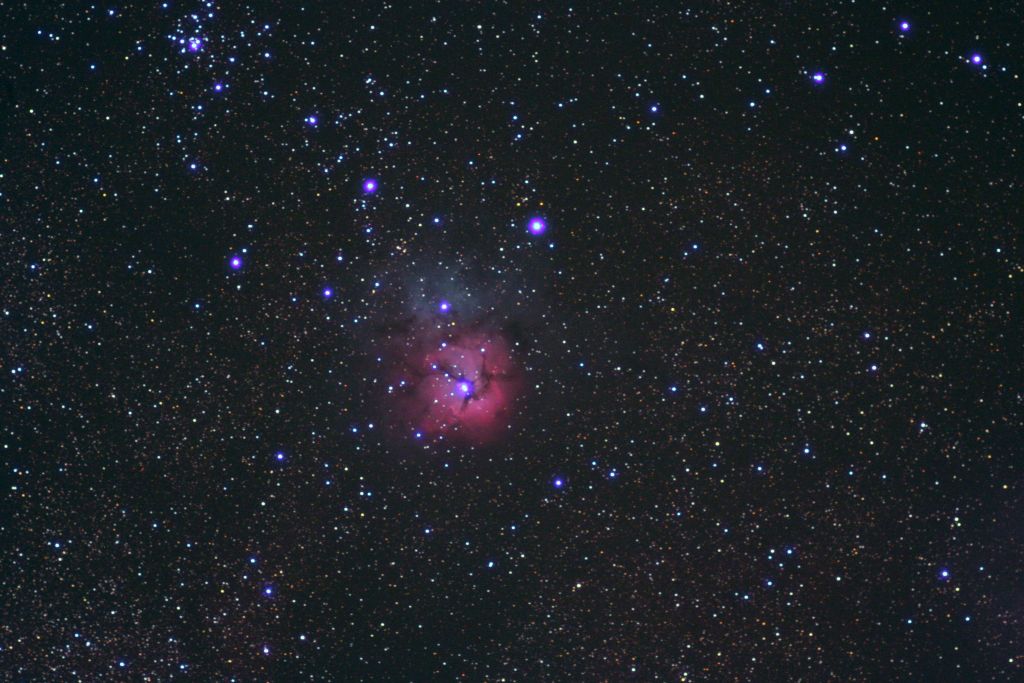 Like a glowing flower in space, the Trifid nebula is suspended in the celestial firmament above the Lagoon nebula in the constellation of Sagittarius the archer. Visually, the colours cannot be seen, and in fact look oddly reversed from that on photographs. This is a wonderful photographic target, that rises high in the sky from mid to tropical latitudes, southwards. The combination of colours arises from general 'dust' that scatters the light, reflecting and enhancing the blue colour of hot stars that light it up, and hydrogen that fluoresces at red and blue wavelengths. Much of the hydrogen light is resonant fluoresent, i.e. glowing back at the extreme ultra-violet wavelengths of 121.6nm and beyond (compared with our visible range 430-630nm). However, this harsh, invisible-coloured light is only detectable above the atmosphere. In this light, our galactic neighbourhood would look vibrant. We just get to see the little red portion (656.3nm) on our photos and, visibly only the tiny fraction that is blue(486.1nm) is detectable to our eyes at night. The picture was taken on a Vixen 4" refractor (with some serious chromatic aberration that I've already reduced) and was just 1 5-minute exposure. Compressed quite badly, or as I would say, Jpegged to high heaven!
Thursday, 14 July 2011
M83
 This is a massive, swirling whirlpool that peeks above our southern hedges for a couple of hours on spring nights. However, head south and it rises right up into the starry heavens! So people like me can snap it like over enthusiastic nerds. The southern pinwheel galaxy, or M83, is part of a local little group, and it is associated with Centaurus A. It is about 15 million light years away. All those little red flecks in it are vast nebulae of fluorescing hydrogen. This pic was taken with an ST-8 at prime focus of the 16 inch relay cassegrain at f/6. Four luminance frames of 5 mins each, 4 luminance darks, plus 1 binned red, green and blue. Unfortunately, the dark that accompanied the colour images had some ghost stars on it, hence the inverse colours I couldn't quite get rid of. I have tidied up this image a lot as it is. It's been crudely processed for web use but still looks great! For example the core is totally whited out - sorry. Compare it to my previous M83 to see the sheer improvement.
omega centauri
 I just crudely edited the aforementioned close up on the software I have available at this moment. Here it is in all (well most of) its glory!
Wednesday, 13 July 2011
omega centauri
 Look at this! I could see it with my naked eye. It was named as a star in Centaurus because it's so bright, but it isn't a star. It's hundreds of thousands of them. It's much too far south to see from Britain. We got a great view of this on the first night through the 16 inch relay-cassegrain scope at astropalma. It was elliptical, which means it must be spinning. But I was impressed enough with seeing it outside through binoculars and then finding it by eye. It's a huge and quite close globular cluster happily orbiting away, floating gently around the middle of our galaxy. I got some close ups too. The little blob above it is amazing too. It is the radio galaxy Centaurus A. I didn't know it was so bright. It looks like an inverted galaxy because it has a bright fuzzy circular background and a dark dusty middle. Obviously you can't see it in this picture, but again I have some close ups, so watch this ... space.
Sunday, 10 July 2011
Amazing place, amazing lens
 I thought I'd do another little advertisment for my equipment and holiday. The lens used in this 30 second shot covers from Scorpius to Polaris! This view was from the plinth at AstroPalma looking across to the astrotrak and remote dome. I hired the f/2.8 Sigma 4.5mm 180 degree fish eye from lenses for hire, and it JUST (or maybe not?) focused with my modified Canon EOS1000D. The trouble with modifying a camera is that the removal of glass makes a tiny difference to the focus. Fortunately most lenses focus a bit beyond infinity, but with this one the tiny TINY focal length made the focus point crucial and it only just made it to focus with the ring at full turn. Phew! It is impossible to use live view at night with this lens - no star is bright enough and Jupiter wasn't risen from behind the mountain. I had to find a street light in this dark sky location. Fancy that, wanting light pollution? Mad.
Wednesday, 6 July 2011
Astronomy is such hard work
 Here, the modified Canon 1000D sits atop the AstroTrak, its sensor receiving aesthetically arranged photons, which hailed from a distant nebula, channeled sweetly through a sigma telephoto lens. The only criticism here is also the thing that makes this photo look good - the damned red light! I lost my bit of tape that goes over it. The 350D's light only came on during data transfer, why did Canon decide to switch it on during the exposure?
Subscribe to:
Comments (Atom)
