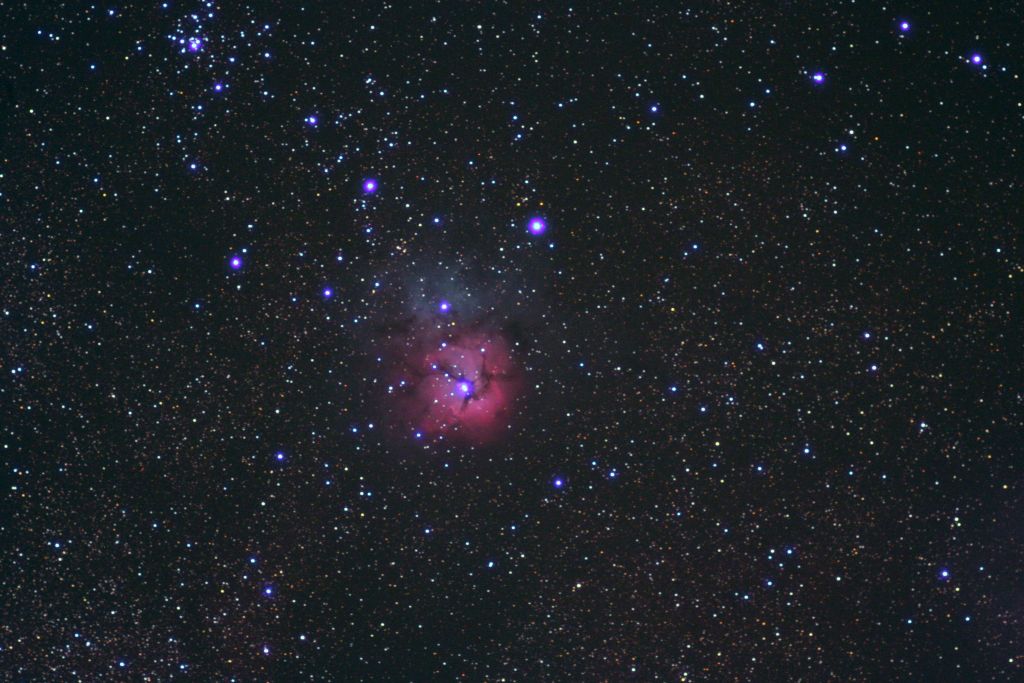
 Like a glowing flower in space, the Trifid nebula is suspended in the celestial firmament above the Lagoon nebula in the constellation of Sagittarius the archer. Visually, the colours cannot be seen, and in fact look oddly reversed from that on photographs. This is a wonderful photographic target, that rises high in the sky from mid to tropical latitudes, southwards. The combination of colours arises from general 'dust' that scatters the light, reflecting and enhancing the blue colour of hot stars that light it up, and hydrogen that fluoresces at red and blue wavelengths. Much of the hydrogen light is resonant fluoresent, i.e. glowing back at the extreme ultra-violet wavelengths of 121.6nm and beyond (compared with our visible range 430-630nm). However, this harsh, invisible-coloured light is only detectable above the atmosphere. In this light, our galactic neighbourhood would look vibrant. We just get to see the little red portion (656.3nm) on our photos and, visibly only the tiny fraction that is blue(486.1nm) is detectable to our eyes at night. The picture was taken on a Vixen 4" refractor (with some serious chromatic aberration that I've already reduced) and was just 1 5-minute exposure. Compressed quite badly, or as I would say, Jpegged to high heaven!
Friday, 15 July 2011
More pretty stuff
Like a glowing flower in space, the Trifid nebula is suspended in the celestial firmament above the Lagoon nebula in the constellation of Sagittarius the archer. Visually, the colours cannot be seen, and in fact look oddly reversed from that on photographs. This is a wonderful photographic target, that rises high in the sky from mid to tropical latitudes, southwards. The combination of colours arises from general 'dust' that scatters the light, reflecting and enhancing the blue colour of hot stars that light it up, and hydrogen that fluoresces at red and blue wavelengths. Much of the hydrogen light is resonant fluoresent, i.e. glowing back at the extreme ultra-violet wavelengths of 121.6nm and beyond (compared with our visible range 430-630nm). However, this harsh, invisible-coloured light is only detectable above the atmosphere. In this light, our galactic neighbourhood would look vibrant. We just get to see the little red portion (656.3nm) on our photos and, visibly only the tiny fraction that is blue(486.1nm) is detectable to our eyes at night. The picture was taken on a Vixen 4" refractor (with some serious chromatic aberration that I've already reduced) and was just 1 5-minute exposure. Compressed quite badly, or as I would say, Jpegged to high heaven!

Thursday, 14 July 2011
M83
 This is a massive, swirling whirlpool that peeks above our southern hedges for a couple of hours on spring nights. However, head south and it rises right up into the starry heavens! So people like me can snap it like over enthusiastic nerds. The southern pinwheel galaxy, or M83, is part of a local little group, and it is associated with Centaurus A. It is about 15 million light years away. All those little red flecks in it are vast nebulae of fluorescing hydrogen. This pic was taken with an ST-8 at prime focus of the 16 inch relay cassegrain at f/6. Four luminance frames of 5 mins each, 4 luminance darks, plus 1 binned red, green and blue. Unfortunately, the dark that accompanied the colour images had some ghost stars on it, hence the inverse colours I couldn't quite get rid of. I have tidied up this image a lot as it is. It's been crudely processed for web use but still looks great! For example the core is totally whited out - sorry. Compare it to my previous M83 to see the sheer improvement.
omega centauri
 I just crudely edited the aforementioned close up on the software I have available at this moment. Here it is in all (well most of) its glory!
Wednesday, 13 July 2011
omega centauri
 Look at this! I could see it with my naked eye. It was named as a star in Centaurus because it's so bright, but it isn't a star. It's hundreds of thousands of them. It's much too far south to see from Britain. We got a great view of this on the first night through the 16 inch relay-cassegrain scope at astropalma. It was elliptical, which means it must be spinning. But I was impressed enough with seeing it outside through binoculars and then finding it by eye. It's a huge and quite close globular cluster happily orbiting away, floating gently around the middle of our galaxy. I got some close ups too. The little blob above it is amazing too. It is the radio galaxy Centaurus A. I didn't know it was so bright. It looks like an inverted galaxy because it has a bright fuzzy circular background and a dark dusty middle. Obviously you can't see it in this picture, but again I have some close ups, so watch this ... space.
Sunday, 10 July 2011
Amazing place, amazing lens
 I thought I'd do another little advertisment for my equipment and holiday. The lens used in this 30 second shot covers from Scorpius to Polaris! This view was from the plinth at AstroPalma looking across to the astrotrak and remote dome. I hired the f/2.8 Sigma 4.5mm 180 degree fish eye from lenses for hire, and it JUST (or maybe not?) focused with my modified Canon EOS1000D. The trouble with modifying a camera is that the removal of glass makes a tiny difference to the focus. Fortunately most lenses focus a bit beyond infinity, but with this one the tiny TINY focal length made the focus point crucial and it only just made it to focus with the ring at full turn. Phew! It is impossible to use live view at night with this lens - no star is bright enough and Jupiter wasn't risen from behind the mountain. I had to find a street light in this dark sky location. Fancy that, wanting light pollution? Mad.
Wednesday, 6 July 2011
Astronomy is such hard work
 Here, the modified Canon 1000D sits atop the AstroTrak, its sensor receiving aesthetically arranged photons, which hailed from a distant nebula, channeled sweetly through a sigma telephoto lens. The only criticism here is also the thing that makes this photo look good - the damned red light! I lost my bit of tape that goes over it. The 350D's light only came on during data transfer, why did Canon decide to switch it on during the exposure?
Tuesday, 5 July 2011
Backlog
 I have had an amazing trip with 100% clear skies. Hence I was spending my time outdoors rather than blogging. However, now I must go to work and process my pics. I have a selection I've done so far of 'exotic' southern milky way objects. Mm-mm-mm! No that's not millimetres, but if you want to know the mm focal length of the instrument used in this pic - it is only 300! Using a starlight express SBIG ST-8 on this little scope gave us this wonderful wide field of Barnard 72, the snake nebula. I have blogged this object before, but never in this much depth or area. This is a single shot of 5 min. I think the scope is around f/6. At the bottom left just off the edge is the star 44 Ophiuchi, which can be used to find these objects. There is a dark kidney bean or cashew nut shaped nebula that is sitting on a star (B74) , going up and right, you come to B70, B69 and then the super dark B68. Over to the left of this field of view is a wonderful big straight dust lane sticking out of the milky way that I could see with my bare eyes!
Friday, 1 July 2011
Bye bye UK sky
 I am currently enjoying the stunning delights of La Palma skies at a little observatory on the west of the island. The faintest stars I could see were 6.0 magnitude against the milky way and the atmospheric transparency is great. They also have a light pollution law here. Here is a picture I processed of the Teapot asterism in the direction of the centre of our Galaxy. I hired a 50mm f/1.4 lens, which I put on my modified Canon 1000D and stopped to f/1.6, and without any tracking whatsoever I got 16 pics of length 15 seconds atop a little gorilla-pod. Sagittarius is so high here it is easy to see the lagoon nebula (top) without binoculars, among many other objects: omega centauri, the dust lanes across Ophiuchus are obvious and 'strange' constellations like Telescopium. You can't beat coming this far south for views of the milky way.
Friday, 17 June 2011
Spirit
The end of the Martian Rover, Spirit.
http://roopeshsingh.blogspot.com/2011/05/heartfelt-goodbye-to-spirited-mars.html
http://roopeshsingh.blogspot.com/2011/05/heartfelt-goodbye-to-spirited-mars.html
Dusty Streak
 I found this unearthly, linear wisp when exploring the outer space behind the sunflower galaxy in Canes Venatici. It’s called NGC 5023, but I had no idea how straight and thin it was, nor how diffuse or hidden its nucleus is. I think some creator was designing something in the sky for us to see. He/she/it drew a line too long and realised he/she/it had made a mistake and rubbed it out. Well it turned out that he/she/it had one of those rubbers that don’t work very well so it left this smudge behind. Or… it could be the creator’s cosmic firework, which is the size of a galaxy, burning up in a black, intergalactic ocean.
Friday, 10 June 2011
Bang
 I can't believe that. My lovely words just all disappeared! It was my best writing ever! I literally highlighted the text then it went white, paused and said "Autosaving draft". The draft was blank. Thanks blogger, I hate you. I hate you. I suppose I better write all that again.
Well...crash, bang, wallop. First it brightened, then fainter, brighter again. What's going on? Well this is a Type II b supernova. It's the little spot on the left of the galaxy. Like any other dying star, its outer layers of hydrogen began to be driven away out into space. Although deep down in the core was a different story. The atoms were frantically and desperately fusing into heavier and heavier elements. Silicon was becoming nickel, which became iron. That's as far as fusion can go. But before much of this was made the helium core alone had reached a point where it's own weight was too much for its atoms. Suddenly, the atoms were crushed and started to mercilessly fall inward to the core. On their way the protons, neutrons and electrons (remember your high school chemistry!) all became neutrons, briefly forming heavy elements like iodine, gold & lead. This was no ordinary ride, the particles were accelerated to thousands of kilometers per second! As the neutrons all neared the centre, they bunched up against one another and made a solid neutron ball. Hitting this brick wall at 1000s of km per second, created a huge, HUGE shockwave that rebounded all the infalling matter back outwards, blasting space with 200 million sunpower of energy. What I saw through my little eyepiece was a point of light. From earth, the view was masked by the outer hydrogen atmosphere. But now this atmosphere has been rendered transparent the full rage of the supernova's energy has come through, causing this second brightening. All of this was happening 23 million light years away, which means it all happened 23 million years ago. Awesome.
Sunday, 5 June 2011
The Sun
 Finally I had all the things come together at the right time (well nearly), the right place, the right weather, etc. to use our Solarscope. The Coronado Solar Max was put on an EQ mount on the observatory annexe's flat roof on Friday evening and I set up as the sun was sinking behind some cirrus clouds. Having achieved such a good North West horizon me and the tripod were very visible and got a toot from a passing car. I grabbed a sequence of shots after many test shots and adjustments (position, ISO, focus, exposure), just as the sun emerged from the bottom of the cloud at 19:30 UT (20:30 BST). After initially thinking that even they were overexposed, I found that it was just the custom white balance settings had made it look that way, and the raw files were fine. However, there is still a gradient across the disk of the sun. I think its because we have such a narrow-band H-alpha filter. The granulation and structure on the sun is AMAZING! And you may also notice that it's flattened by atmospheric refraction. I know there are better pics out there but I'm well impressed - this is my first serious attempt.
Processingwise, I input the 11 x 0.04s Canon(modded) raw 10Mpixel files in Registax and they stacked very slowly - it's the only program that worked. I sharpened up the monochome output. I added a yellow colourize, rotated and flipped to correct for the diagonal mirror. Then I masked out the bright disk and turned the atmosphere a beautiful shade of hydrogen red!
Wednesday, 1 June 2011
Perspective
 The moon (la lune/luna, der Mond, y lleuad, etc.) is seen in such different ways. It's a matter of perspective. I don't mean technically, like lines shrinking away to vanishing points, but a human sense of a different perception. I was walking through a beautiful rural/suburban landscape on a Sunday afternoon (April 10) and I looked up at a tree to see the moon behind it. I had my 400mm telephoto lens with me so I took a pic and to my annoyance the moon was not in focus with the tree. So I carefully focused on each one and spliced the pics together. Typical photography... it's all about seemlessly cheating, but as I was playing around, I had the idea of upping the contrast to the point where it posterized the colours. This made the faint wispy cirrus stand out, and a couple of flecks of dust unfortunately, but I like them. Unfortunately the extra contrast meant I had to be extremely seemless in joining the pics, so after a little tweak here and there I was happy with this. A different perspective on the moon. There are lots of things you could say about this. There's a lot of texture. A round moon caught between spidery, spindly branches and a soft, sketchy cirrus. Hmm I'll shut up now. I just like it.
Monday, 30 May 2011
Supernova
 This is SN2011at in PGC26905 Hydra. I would like to get into doing something useful so I thought I’d make a start by finding what supernovae were out there. I found this on AAVSO.org (American Association of Variable Star Observers). Variable stars are not really my interest, but making an accurate measurement of the brightness (photometry) would give me some satisfaction, and if it were to become easy or routine to measure, it might just become rewarding enough to contribute to ‘citizen science’. I have authored a few papers so am aware of what is required, and it is usually a lot of work and stress being accurate enough. However, with the equipment here in front of me it seems a bit of a shame to use it on frivolous fancy pictures alone (as lovely as they are!). Now we have an Atik, we just need a V filter to speed up the process. The trouble with photometry with a DSLR is the green channel data only approximates a V filter and needs to be corrected using the colour (Blue-Visible) value as well as the atmospheric extinction and field flatness.
I got an estimate of 14.90mag at 2320UT (06/04/2011) but that could have been out by + or – 0.20mag and I didn’t have a good selection of reference star data (error based on differences between reference stars and measured values). If B-V for the supernova is 0 then there is a +0.13 correction, so it is 15.03 mag, if B-V=0.7 then correction is 0. The image was also so blurred that the supernova light mixed with the galaxy and some nearby stars. So there could be another + correction. Still … pretty good for a start, and for a faint PGC galaxy low down in Southern Hydra.
Sunday, 29 May 2011
29P/Schwassmann-Wachmann (1) 2345-2351UT 06-04-2011
 This faint comet was swimming through Sextans near Southern Leo and it plunges back through the border into Leo in late June 2011. Normally its feeble luminosity would hover around 13th magnitude, but it had had a little outburst that peaked around the time of my 6x1 minute photos (April 6 2011), putting it at perhaps 12th mag. As is usual with comets to me, they look much fainter. As well as dust in the comet's tail, there is some dust obviously on my camera's sensor.
The Headphones Nebula
 This secretive little critter is lurking in the unlikely constellation of Lynx (the Lynx in case you didn’t guess). For some reason, you don’t normally find planetary nebulae there. It is called Jones-Emberson 1 (PK 164+31.1). The same Mrs Jones, I believe, that discovered Jones 1 in Pegasus. It looks about as faint as Jones 1, although is listed as brighter. As all astro-imagers say “it needs more exposure”; I only got 10 minutes of good enough quality images. Well, yes, it is a noisy (grainy) image, but it is also one of those very pleasing rare and unusual objects. The nebula looks a little bit ‘on the skew’ but is roughly symmetrical, making it not really look like its moniker above. I had to restack this using the super pixel mode on Deep Sky Stacker to get it to pick 10 1 minute frames, rather than the original 8. I’m a big fan of the super pixel mode – it combines the 2x2 colour matrix into one nice coloured pixel, and means I am not over sampling the image as much. Plus it speeds things up by a factor of 4.
The Spindle Galaxy
 It's a galaxy in Sextans (NGC3115). I like the abbreviation for that constellation.
M61
 We got an Atik CCD! Woohoo! It’s a 383+, with an 8.3 megapixel 22mm diagonal Kodak chip. Here is a picture of M61, luminance. Stacked in Maxim from 30 x 1 min pics binned 3x3 (9 pixels read out as 1 for extra sensitivity) with the camera at -10deg C. I’ve processed it so you can see all those extra faint outer spiral arms and galaxies around it. I was struggling to combine the 2 x 1 minute Red Green and Blue exposures with the Luminance – the result is below, detrailed a little. Now we’re just fighting against tracking errors and light pollution!


** NEBULA CAUGHT HIDING IN CLUSTER **
 The star Sirius twinkles on a late winter’s evening. Around it the stars of the greater dog, Canis Major lie. If you imagine a line between the dogs front leg and Sirius, extend it back through Sirius 2 – 3 lengths you will come to the star clusters M46 and M47. This is a close up on the North of M46, with all the brighter stars on the image being cluster members. As you can see there is a planetary nebula (NGC 2438) lying in the same direction as this cluster, which I have brought out in the processing. The nebula is probably closer to us than the cluster, and thus is not really hiding within it. It’s a nice thing to view but sadly we’ll have to wait until late in the year before this curious alignment is in our skies again. I moved the blue down and red up to correct for the atmospheric refraction messing up my pictures of low objects!
Pastel shades of wispy gas
 I stuck an 8 inch mask on the 20 inch to cut down the blurring effects of seeing, not realising that by doing a long exposure would reintroduce the blur. Nevertheless, because I was pointing the scope at such a beautiful bright region of spacetime, I captured a pretty pastel picture of these wisps of gas without diffraction spikes. There is a little tuft on the edge of each star, presumably caused by the central mirror edge protruding slightly into the 8 inch mask. I may have saturated the trapezium at the centre, but the nebula centres have come out deliciously mottled and shaded. Especially, see the star at centre bottom with a deep shadow next to it.
Thursday, 28 April 2011
Sombrero!
 The billions of stars that make this wonderful smooth shape, which appears nearly edge on from our Galaxy, lie 29 million light years away, in the south of the constellation of Virgo. This vast stellar city is nicknamed the Sombrero galaxy for obvious reasons. Officially known as M104, you can see the bright nucleus, and sharp, symmetrical dust lane around the edge. There are also 1 or 2 background galaxies visible. M104 has been imaged in infrared light that penetrates the galaxy to show the dust lane going all the way around. It's an incredibly aesthetically pleasing object that 'floats' in the sky like saturn with its ring. It lies quite a way outside (south) of the main Virgo galaxy cluster, but is quite bright due to that nucleus. It is a little smaller than you may expect, and the dust lane can be seen with a moderate telescope from the UK, low in the southern sky in spring. This picture was composed from just 7 x 1-minute exposures on the 20-inch BAS scope at f/3 (along with some daylight flat fields that didn't work). It just looks beautiful to me.
Tuesday, 19 April 2011
Jellyfish
 Now I’ve got my modified camera – look at all the red stuff it reveals. This is the jellyfish nebula that I blogged before. I can now see all the red stuff - Hydrogen galore! – it’s like taking off a pair of sunglasses. I mosaiced 2 pics here. Both were guided on Propus, which is responsible for the shard of light you can see just off the bottom. The jellyfish gives a lovely impression of the nebula floating in the vast sea of the heavens.
Abell 31
 I know I’ve been going for faint targets, but this one has taken 7 or 8 attempts and exposing various equipment flaws that have shown up along the way. When I finalise the stack of 30 or 40 images, I still see nothing. Possibly a few grainy speckles appear on stretching the contrast. I had to combine 2 or 3 sets of stacks, and keep blurring, brightening, adjusting the variation in the background. It was virtually a month’s project and rather futile really, as there are some much better pictures, with much better equipment out there. Why do I do it? Because I can, and I enjoy persevering with the equipment to see what it can achieve. This thing is so big and faint that it is 0.4% brighter than the overhead light pollution background level (SQM reading averages 21.0). It’s probably even less than that at the altitude I took it at… and I cannot get a decent flat field image! So, all things considered, it might look a bit ugly, but it’s a monster. A strange, old monster that’s dissipating slowly into space. Search for it under PK219+31.1 or Abell 31 (details: 12.2m/17’x16’ – that’s big).
IC 2162
 What the hell is this? It looks like some invisible steam train, But then one cloud looks like a poppy. Don’t overlook the little fuzzy on the left. There is a beautiful juxtaposition with the star at far left, which is too faint to be seen with the naked eye. The object here is catalogued as IC 2162 and it appears here a collection of nebulae which are in Orion’s right arm. I wonder if it is connected with the nearby Monkey nebula (below). It’s a relatively smooth picture, as this was quite bright compared to my other subjects, and high in the dark, clear part of the sky. It took about 10 minute exposures to capture this weird thing.
Abell 29
 Two red arcs take their trip across the southern sky
Unseen to all passers by
They were once a star that started to die
Surely that must be the first poem written about Abell 29 (PK244+12.1)? The nebula is hidden behind a grainy fog because it’s incredibly faint (14.3m/6x4’) and low down in the constellation of Pyxis the Mariner’s Compass. The grain is inherent in the camera. It took about half an hour’s worth of minute exposures at f/3 on the 20-inch with the modified Canon 1000D. Also a lot of teasing and tweaking was involved in the processing. I keep thinking I can see a hint of blue inside the red arcs. Hmm… a bit of an achievement from the UK, this one.
Abell 21
 This large planetary nebula is more of a ragged, asymmetric set of vast gaseous arcs strewn across the outer shell of a little dying star’s former atmosphere. The star is tiny, and shining with an extremely hot blue colour (at magnitude 15.9). If you look carefully, you can see the little blue dot at the centre of the arc. The picture reveals some blue oxygen and hydrogen (beta) emission nearer the centre and more reddish strands further out – presumably hydrogen (alpha) and some sulphur ions. This nebula is known as the Medusa nebula (Abell 21, PK205+14.1) and is located in the South of Gemini. I see Barnfield Bob (see friends) has beaten me to blog an image of this. His optics and tracking are quite superior to the twenty inch I use. Still, I think this stack of about 20 minute-long snaps (+ flats & darks) has revealed a lot of detail in this object. I have tried imaging this object before several times and not been happy with the result on the non-converted camera and unguided scope. I have seen it visually in the scope, and it is quite impressive (the scope is the impressive thing!). It was relatively easy when high in the sky on a dark winter’s night, although an Ultra High Contrast filter was necessary to reveal the ghostly, filamentary details.
Thursday, 7 April 2011
By observing, we introduce a human element to what’s really there.
 On one of my rare moments of astronomy time I was aiming the big scope to a patch of nebulosity I had seen in the south of the constellation Monoceros, the unicorn. It was supposed to be the seagull nebula, but I was slightly off in my positioning and was attracted to this rather brighter nebula to the upper right instead. It was around the star HIP34116 (a mag. 7 sub-arcsecond double) and it looked like a heart on my camera, but on processing the heart shape appeared again in a larger form. I’m sure it’s not just me that can see a heart. What’s more, a broken heart! A giant heart-shaped nebula - it always amazes me what stuff is up there. However, hearts don’t really look that shape, I’ve seen quite a few dissected. The shape, called a cardoid (for reasons you may well suss out), is a name for a type of mathematical curve, θ = r². I conclude thus mathematics is related to biology (and that was via astronomy). P.S. As I'm posting this, a Radio 4 programme on maths in biology has just come on.
Sigur Rós
 This is the rosette nebula (NGC 2237,8). A beautiful rosy coloured object, with filaments, dark lanes, dusty blobs, and meandering, snaking streamers all lit up by a bright cluster of stars at the centre of the central chasm (NGC 2239,2244). It looks like a tunnel, as I am trying to imagine it in three dimensions. I see one of the stars, the bright one at the centre I used to guide the telescope, is slightly yellower than the others. This object is depending on what instrument you are using, annoyingly or satisfyingly large. By annoyingly large, I mean that it won’t come close to fitting into my camera field on the big scope, even with a field-widening lens on it. If you are slightly more impressed with the sharpness of the stars on this pic, it is because I had to mosaic 4 pictures together. As is usual, I don’t want to spend all night on the scope and so I just took one single 1 minute exposure on each quarter of this final image, and merged them all, manually at home. Just 1 minute exposure - that’s nothing, for such a wonderful amount of detail. Perhaps I should do a 3x3 or 4x4 mosaic to get even more of it in, but the astronomer has precious little time. Here is a rough calculation of the time astrophotographers have to work. 60% it is too light because of twilight or the sun is up (depends on latitude). 50% of the time the moon is up, making it too light. 50% of the time it is inconvenient to get to the observatory (plus we need to sleep). 70% of the time it is too cloudy (depends on how much cloud your country loves). 50% of the time your equipment doesn’t work or doesn’t work properly. That’s 40% x 50% x 50% x 30% x 50% = 1½%.
Retro Computer Games
 Here is my latest one of the Pacman Nebula in Cassiopeia, captured with about 5 minute exposures on my modified Canon 1000D on the ‘big scope’. He is eating the pills (the stars), although there are quite a few more of them here than in the 80’s arcade game. The nebulosity is more extensive thanks to the camera filter removal (the modification mentioned above). The nebula looks like it has been trailed or blurred, but it actually is like that. The dust lanes have a very wispy appearance. The prominent one is the dark spot at the top, which you can take as the ‘eye’, although I prefer to see the eye as the bright blue cluster (NGC 281). Not a very long exposure was required for this one – I even picked it up in a single 1 minute shot through a 135mm f/2.8 lens and a bit of processing. However I could have done with a fractionally wider field and a better angle.
So faint… it isn’t actually there.
 George Abell spotted his 17th splodge on the deep sky survey in this location and classified it as a faint planetary nebula (a fluorescent stellar corpse) of 18.5 magnitude. This is in the realms of extremely dim, 1/40th as bright as Pluto, and Pluto is 1/2500th as bright as the faintest star you can see with the naked eye, and that is dimmed further by being smeared over a small area. The red smear across the top of the photo represents a lesson in how to be careful when taking space photos. It must have been caused by the red computer mouse light from across the dome! When you get into the realms of extremely dim everything’s too light. Phones are out of the question and monitors must certainly be off. Plus there’s an annoying LED that comes on my new camera while it’s exposing. How dumb. Notwithstanding the distracting straight line upper right of centre, I have marked the location and size of the nebula on the photo, where I can sort of half-imagine a very faint reddish ring. Well this was later classed as not a nebula at all it was a plate flaw, which was obvious and just to the left of my marked area. Is it a circular collection of stars below the detection limit of the instrument? Or is it just that the background ‘static’ noise in my camera has fortuitously created a false nebula in combination with a computer mouse?
Sunday, 20 March 2011
Celestial bodies and the oddities of their motion
 Here is a picture of the sky some minutes after sunset on 19th March 2011, looking west across the city of Norwich. Actually it is a combination of 16 pictures through the 135mm lens on the Canon 350D. I didn’t combine in the usual way by pinning the stars down, but by just placing one on top of the other and each time just choosing the lighter of the two pixels from above or below. The result, I hoped, would tend to minimise the cloud by preferentially letting the lighter sky through. Luckily the camera was very still on its tripod through this period in which I was graced with a passing interested chap who had popped home to bring his wife along, at which point a plane decided to make my picture sequence a little more interesting. I wonder whether the crew and passengers knew that they were passing so close to the planet Mercury, the upper “star” and whether it looked like a huge bright ball out of their windows. I jest of course.
The 16 pictures show the even descent of Mercury and Jupiter (the lower “star”) at the angle of <37.5º caused by the earth’s rotation. Mercury is at its widest separation left or west of the sun and the plane of its orbit pokes up northward from our perspective at spring dusk making it higher for us in the northern hemisphere. Mercury at this point is the same distance as the sun. On the other hand, we are waving bye bye to Jupiter as it is way beyond the sun and so is ‘sinking rapidly into the twilight’. The twilight is getting earlier as we approach summer, and the orbit of the Earth is moving so that the sun appears to approach Jupiter, which looks as bright as Mercury, but is 6 times further away. Mercury is moving more rapidly around the sun (88 days long is its year), so it appears to move with the sun and will stick around for a few more days, until it decides to pop up in the dawn sky for those nearer the southern hemisphere. While all this is happening in a darkening sky, I can see the Orion Nebula, Sirius the Dog Star, and in the cold wind the so-called supermoon is rising behind me. The closest point of its orbit has happened to coincide with full moon as it’s swinging around us on Earth. From my perspective on this rotating spheroid, Jupiter had disappeared and been replaced with a very bright patchy grey face shining through the trees. Naked-eye astronomy is pretty inspiring sometimes.
The supermoon is doing weird things to us all
 It’s so bright!!!!! Ahhhhh! There are a lot of weird things being suggested about the supermoon. Crazy tides (well slightly bigger tides, yes that’s true). But the spate of disasters? No. Nor is it anything to do with the end of the world in 2012. It is just the moon… a little bit closer to Earth than usual… and at full moon… Still, there’s always fear of the unknown…. Aaaah! Panic! Technicially it’s the brightest moon for years, but by the tiniest amount. The same went for Mars in 2003. The word for the closest point on an orbit around Earth is perigee, and the furthest, apogee (geo-). This goes for the sun: perihelion and aphelion. Also, any lunar probes would have an periselene & aposelene. A bit like an apex. In these pics the moon is at perigee and 356 577 km away. Canon350D ISO400 135mm f/2.8 10”, plus f/16 1/640” for detail.
Sunday, 13 March 2011
Modified EOS 1000D vs EOS 350D
 Here is the crab nebula, a supernova remnant that exploded in 1054AD(our time), and was witnessed as the ‘daylight star’ in China. It is a nice target to image for a test, as it contains red filaments surrounding a blue cloud. The red light comes from “hydrogen balmer alpha”, which means an electron in an excited atom of hydrogen drops from quantum level 3 to level 2. The blue light mostly comes from “hydrogen balmer beta”, which is from 4 to 2, a larger drop in energy giving a more energetic photon of light, i.e. a ‘blue’ photon is more energetic than a 'red' one. The purposes of “modifying” a new 1000D (thanks dslrastromod) is to enable most of that alpha light to get to the camera sensor. Roughly 4 times as much. You can see that effect here in this before and after shot. It’s not a proper comparison as the first one was about 10 x 30 second pictures on a 350D, and the second was 6 x 1 minute pictures and both could have been taken with different background brightnesses. But I think you can work out how pleased I am to have improved my astronomical capabilities by such a large jump.
Wednesday, 2 March 2011
Blip… there goes another star.
 I remember being shown this amazing object for the first time in a new 12 inch Dobsonian at Norwich Astronomy Society by a guy who knew his way around the sky and had just hunted this thing down. There was quite a queue after quite a quirky astronomical quest. This object lies in the constellation of Cassiopeia - the Queen of Ethiopia, and you would think it easy to find: "just past the ‘W’ shape, to 4 Cas, then across a bit, past the cluster M52"… but I can never find the damn thing by star-hopping. On this occasion I had the luxury of a computer, which takes the challenge out of it, but my sky knowledge is useful every time there is a system error. With autoguiding on the star in the frame above, the position of this object in the sky allowed 1 minute exposures before too much rotation occurred. A few of these later, I revealed the blue bubble cast out by the star’s stellar wind, set against the surrounding interstellar redglowing hydrogen. There is also the strange, pinkish bar close by the central star, which is itself offset slightly from the centre of the bubble. It looks like this enraged star is hurtling along while blasting away 10 light years of space around it (that’s a 30 million million mile radius) with its fierce radiation.
'Icy' 348
 By the star Atik, in the constellation of Perseus, hides this faint reflection off interstellar dust. It is now thought that Atik is not associated with this reflection and that the cluster within it, IC 348, lights it up. Giving a very icy visual impression the reflection nebula is on the other side of the cloud I showed you in the last post. The dazzlingly bright Atik looks so much closer to us than the nebula but you must bear in mind stars have a vast range of luminosities. While it is visible as a shimmering point of light here, and to the naked eye above the Pleiades in the autumn, winter and spring, the star is actually two - a blue giant, with a blue dwarf orbiting it in 4 ½ days that mutually distort each other into rugby ball shapes. And the larger is indeed luminous, as it is probably a good deal greater than 1000 light years away AND it has dust in the way. Otherwise known as just plain old ‘omicron Persei’, Atik is referred to in a certain fictional account as having a system of planets surrounding it, colonised by a race of giant horned toad creatures, where the 8th planet is ruled by the despotic leader, Lrrr.
Sunday, 6 February 2011
Looking into the vast pit of darkness
 In the south of the constellation of Perseus lies an immense cloud of dust that light cannot penetrate. It is about 600 light years away and weighs more than 10,000 suns, although perversely, the individual dust particles are mostly less than a thousandth of a millimetre across. Beyond the dust is so dark that you can’t see where the edge is, other than the sudden absence of stars. A glimmer of light emerges from the near edge of this cloud. The glow was given the imaginative name of NGC 1333. This was for the purposes of cataloguing, but given its intriguing, ethereal appearance I bet someone out there has called it something. There are some super deep pictures of this on the web, and had I used a red-sensitive camera I would be looking at some sparkly bits to the lower edge of the picture. All that shows up on my picture is a very faint line near the bottom.
The lion's head galaxy
 …a lovely galaxy that lives in the head of Leo, the lion. Here’s my new and improved version – like it? It’s still not perfect, but I took one of these before the autoguiding camera and new motors and it’s not a patch on this picture. You can see the smudge of light coming from galaxy UGC 5806 (thanks barnfieldbob) and a couple more faint, tiny (I suspect I really mean distant) galaxies to the lower right. This galaxy is surprisingly easy to see and should have been picked up by Charles Messier before William Herschel discovered it. You can see a giant nebula within this galaxy – NGC 2905, which (I think) is the blob just off to the lower right. The galaxy is classified as SBd (barred spiral) because there is a diffuse, broken bright white bar full of star clusters and nebulae across the centre.
Kohoutek2_1 a.k.a. PK173-5.1…catchy name.
 The reason this nebula hasn’t got a decent name is because it is faint and quite amorphous unless, of course, you like one of the names above. The nebula’s feeble 13.8(photographic) magnitude light extends quite a way: over a 2.2 arcminute-sized smear. This planetary nebula is a bit of a cosmic mystery insomuch as it's difficult to tell what type it is. It was difficult to photograph, mainly because I aimed my telescope perfectly, but it appeared after development at the lower edge of my picture. My original calibration was with a poor flat field, which was not good at the edge, although I had done a good job processing: blurring, increasing contrast and masking the stars, background removal etc., etc.. You can see the purple noise where the background subtraction went a bit wrong and the glow on the right from the camera sensor’s amplifier. I show you here the cropped edge of the picture where this glob of stellar snot was hiding. There’s a distinctive pattern of stars on the left that one could use as a sign post. I might try and find this ‘faint fuzzy’ visually on a good night, as it is 12th magnitude to the eye and high in the sky just below the outline of Auriga the charioteer.
Subscribe to:
Posts (Atom)
