 On one of my rare moments of astronomy time I was aiming the big scope to a patch of nebulosity I had seen in the south of the constellation Monoceros, the unicorn. It was supposed to be the seagull nebula, but I was slightly off in my positioning and was attracted to this rather brighter nebula to the upper right instead. It was around the star HIP34116 (a mag. 7 sub-arcsecond double) and it looked like a heart on my camera, but on processing the heart shape appeared again in a larger form. I’m sure it’s not just me that can see a heart. What’s more, a broken heart! A giant heart-shaped nebula - it always amazes me what stuff is up there. However, hearts don’t really look that shape, I’ve seen quite a few dissected. The shape, called a cardoid (for reasons you may well suss out), is a name for a type of mathematical curve, θ = r². I conclude thus mathematics is related to biology (and that was via astronomy). P.S. As I'm posting this, a Radio 4 programme on maths in biology has just come on.
Thursday, 7 April 2011
By observing, we introduce a human element to what’s really there.
On one of my rare moments of astronomy time I was aiming the big scope to a patch of nebulosity I had seen in the south of the constellation Monoceros, the unicorn. It was supposed to be the seagull nebula, but I was slightly off in my positioning and was attracted to this rather brighter nebula to the upper right instead. It was around the star HIP34116 (a mag. 7 sub-arcsecond double) and it looked like a heart on my camera, but on processing the heart shape appeared again in a larger form. I’m sure it’s not just me that can see a heart. What’s more, a broken heart! A giant heart-shaped nebula - it always amazes me what stuff is up there. However, hearts don’t really look that shape, I’ve seen quite a few dissected. The shape, called a cardoid (for reasons you may well suss out), is a name for a type of mathematical curve, θ = r². I conclude thus mathematics is related to biology (and that was via astronomy). P.S. As I'm posting this, a Radio 4 programme on maths in biology has just come on.

Sigur Rós
 This is the rosette nebula (NGC 2237,8). A beautiful rosy coloured object, with filaments, dark lanes, dusty blobs, and meandering, snaking streamers all lit up by a bright cluster of stars at the centre of the central chasm (NGC 2239,2244). It looks like a tunnel, as I am trying to imagine it in three dimensions. I see one of the stars, the bright one at the centre I used to guide the telescope, is slightly yellower than the others. This object is depending on what instrument you are using, annoyingly or satisfyingly large. By annoyingly large, I mean that it won’t come close to fitting into my camera field on the big scope, even with a field-widening lens on it. If you are slightly more impressed with the sharpness of the stars on this pic, it is because I had to mosaic 4 pictures together. As is usual, I don’t want to spend all night on the scope and so I just took one single 1 minute exposure on each quarter of this final image, and merged them all, manually at home. Just 1 minute exposure - that’s nothing, for such a wonderful amount of detail. Perhaps I should do a 3x3 or 4x4 mosaic to get even more of it in, but the astronomer has precious little time. Here is a rough calculation of the time astrophotographers have to work. 60% it is too light because of twilight or the sun is up (depends on latitude). 50% of the time the moon is up, making it too light. 50% of the time it is inconvenient to get to the observatory (plus we need to sleep). 70% of the time it is too cloudy (depends on how much cloud your country loves). 50% of the time your equipment doesn’t work or doesn’t work properly. That’s 40% x 50% x 50% x 30% x 50% = 1½%.
Retro Computer Games
 Here is my latest one of the Pacman Nebula in Cassiopeia, captured with about 5 minute exposures on my modified Canon 1000D on the ‘big scope’. He is eating the pills (the stars), although there are quite a few more of them here than in the 80’s arcade game. The nebulosity is more extensive thanks to the camera filter removal (the modification mentioned above). The nebula looks like it has been trailed or blurred, but it actually is like that. The dust lanes have a very wispy appearance. The prominent one is the dark spot at the top, which you can take as the ‘eye’, although I prefer to see the eye as the bright blue cluster (NGC 281). Not a very long exposure was required for this one – I even picked it up in a single 1 minute shot through a 135mm f/2.8 lens and a bit of processing. However I could have done with a fractionally wider field and a better angle.
So faint… it isn’t actually there.
 George Abell spotted his 17th splodge on the deep sky survey in this location and classified it as a faint planetary nebula (a fluorescent stellar corpse) of 18.5 magnitude. This is in the realms of extremely dim, 1/40th as bright as Pluto, and Pluto is 1/2500th as bright as the faintest star you can see with the naked eye, and that is dimmed further by being smeared over a small area. The red smear across the top of the photo represents a lesson in how to be careful when taking space photos. It must have been caused by the red computer mouse light from across the dome! When you get into the realms of extremely dim everything’s too light. Phones are out of the question and monitors must certainly be off. Plus there’s an annoying LED that comes on my new camera while it’s exposing. How dumb. Notwithstanding the distracting straight line upper right of centre, I have marked the location and size of the nebula on the photo, where I can sort of half-imagine a very faint reddish ring. Well this was later classed as not a nebula at all it was a plate flaw, which was obvious and just to the left of my marked area. Is it a circular collection of stars below the detection limit of the instrument? Or is it just that the background ‘static’ noise in my camera has fortuitously created a false nebula in combination with a computer mouse?
Sunday, 20 March 2011
Celestial bodies and the oddities of their motion
 Here is a picture of the sky some minutes after sunset on 19th March 2011, looking west across the city of Norwich. Actually it is a combination of 16 pictures through the 135mm lens on the Canon 350D. I didn’t combine in the usual way by pinning the stars down, but by just placing one on top of the other and each time just choosing the lighter of the two pixels from above or below. The result, I hoped, would tend to minimise the cloud by preferentially letting the lighter sky through. Luckily the camera was very still on its tripod through this period in which I was graced with a passing interested chap who had popped home to bring his wife along, at which point a plane decided to make my picture sequence a little more interesting. I wonder whether the crew and passengers knew that they were passing so close to the planet Mercury, the upper “star” and whether it looked like a huge bright ball out of their windows. I jest of course.
The 16 pictures show the even descent of Mercury and Jupiter (the lower “star”) at the angle of <37.5º caused by the earth’s rotation. Mercury is at its widest separation left or west of the sun and the plane of its orbit pokes up northward from our perspective at spring dusk making it higher for us in the northern hemisphere. Mercury at this point is the same distance as the sun. On the other hand, we are waving bye bye to Jupiter as it is way beyond the sun and so is ‘sinking rapidly into the twilight’. The twilight is getting earlier as we approach summer, and the orbit of the Earth is moving so that the sun appears to approach Jupiter, which looks as bright as Mercury, but is 6 times further away. Mercury is moving more rapidly around the sun (88 days long is its year), so it appears to move with the sun and will stick around for a few more days, until it decides to pop up in the dawn sky for those nearer the southern hemisphere. While all this is happening in a darkening sky, I can see the Orion Nebula, Sirius the Dog Star, and in the cold wind the so-called supermoon is rising behind me. The closest point of its orbit has happened to coincide with full moon as it’s swinging around us on Earth. From my perspective on this rotating spheroid, Jupiter had disappeared and been replaced with a very bright patchy grey face shining through the trees. Naked-eye astronomy is pretty inspiring sometimes.
The supermoon is doing weird things to us all
 It’s so bright!!!!! Ahhhhh! There are a lot of weird things being suggested about the supermoon. Crazy tides (well slightly bigger tides, yes that’s true). But the spate of disasters? No. Nor is it anything to do with the end of the world in 2012. It is just the moon… a little bit closer to Earth than usual… and at full moon… Still, there’s always fear of the unknown…. Aaaah! Panic! Technicially it’s the brightest moon for years, but by the tiniest amount. The same went for Mars in 2003. The word for the closest point on an orbit around Earth is perigee, and the furthest, apogee (geo-). This goes for the sun: perihelion and aphelion. Also, any lunar probes would have an periselene & aposelene. A bit like an apex. In these pics the moon is at perigee and 356 577 km away. Canon350D ISO400 135mm f/2.8 10”, plus f/16 1/640” for detail.
Sunday, 13 March 2011
Modified EOS 1000D vs EOS 350D
 Here is the crab nebula, a supernova remnant that exploded in 1054AD(our time), and was witnessed as the ‘daylight star’ in China. It is a nice target to image for a test, as it contains red filaments surrounding a blue cloud. The red light comes from “hydrogen balmer alpha”, which means an electron in an excited atom of hydrogen drops from quantum level 3 to level 2. The blue light mostly comes from “hydrogen balmer beta”, which is from 4 to 2, a larger drop in energy giving a more energetic photon of light, i.e. a ‘blue’ photon is more energetic than a 'red' one. The purposes of “modifying” a new 1000D (thanks dslrastromod) is to enable most of that alpha light to get to the camera sensor. Roughly 4 times as much. You can see that effect here in this before and after shot. It’s not a proper comparison as the first one was about 10 x 30 second pictures on a 350D, and the second was 6 x 1 minute pictures and both could have been taken with different background brightnesses. But I think you can work out how pleased I am to have improved my astronomical capabilities by such a large jump.
Wednesday, 2 March 2011
Blip… there goes another star.
 I remember being shown this amazing object for the first time in a new 12 inch Dobsonian at Norwich Astronomy Society by a guy who knew his way around the sky and had just hunted this thing down. There was quite a queue after quite a quirky astronomical quest. This object lies in the constellation of Cassiopeia - the Queen of Ethiopia, and you would think it easy to find: "just past the ‘W’ shape, to 4 Cas, then across a bit, past the cluster M52"… but I can never find the damn thing by star-hopping. On this occasion I had the luxury of a computer, which takes the challenge out of it, but my sky knowledge is useful every time there is a system error. With autoguiding on the star in the frame above, the position of this object in the sky allowed 1 minute exposures before too much rotation occurred. A few of these later, I revealed the blue bubble cast out by the star’s stellar wind, set against the surrounding interstellar redglowing hydrogen. There is also the strange, pinkish bar close by the central star, which is itself offset slightly from the centre of the bubble. It looks like this enraged star is hurtling along while blasting away 10 light years of space around it (that’s a 30 million million mile radius) with its fierce radiation.
'Icy' 348
 By the star Atik, in the constellation of Perseus, hides this faint reflection off interstellar dust. It is now thought that Atik is not associated with this reflection and that the cluster within it, IC 348, lights it up. Giving a very icy visual impression the reflection nebula is on the other side of the cloud I showed you in the last post. The dazzlingly bright Atik looks so much closer to us than the nebula but you must bear in mind stars have a vast range of luminosities. While it is visible as a shimmering point of light here, and to the naked eye above the Pleiades in the autumn, winter and spring, the star is actually two - a blue giant, with a blue dwarf orbiting it in 4 ½ days that mutually distort each other into rugby ball shapes. And the larger is indeed luminous, as it is probably a good deal greater than 1000 light years away AND it has dust in the way. Otherwise known as just plain old ‘omicron Persei’, Atik is referred to in a certain fictional account as having a system of planets surrounding it, colonised by a race of giant horned toad creatures, where the 8th planet is ruled by the despotic leader, Lrrr.
Sunday, 6 February 2011
Looking into the vast pit of darkness
 In the south of the constellation of Perseus lies an immense cloud of dust that light cannot penetrate. It is about 600 light years away and weighs more than 10,000 suns, although perversely, the individual dust particles are mostly less than a thousandth of a millimetre across. Beyond the dust is so dark that you can’t see where the edge is, other than the sudden absence of stars. A glimmer of light emerges from the near edge of this cloud. The glow was given the imaginative name of NGC 1333. This was for the purposes of cataloguing, but given its intriguing, ethereal appearance I bet someone out there has called it something. There are some super deep pictures of this on the web, and had I used a red-sensitive camera I would be looking at some sparkly bits to the lower edge of the picture. All that shows up on my picture is a very faint line near the bottom.
The lion's head galaxy
 …a lovely galaxy that lives in the head of Leo, the lion. Here’s my new and improved version – like it? It’s still not perfect, but I took one of these before the autoguiding camera and new motors and it’s not a patch on this picture. You can see the smudge of light coming from galaxy UGC 5806 (thanks barnfieldbob) and a couple more faint, tiny (I suspect I really mean distant) galaxies to the lower right. This galaxy is surprisingly easy to see and should have been picked up by Charles Messier before William Herschel discovered it. You can see a giant nebula within this galaxy – NGC 2905, which (I think) is the blob just off to the lower right. The galaxy is classified as SBd (barred spiral) because there is a diffuse, broken bright white bar full of star clusters and nebulae across the centre.
Kohoutek2_1 a.k.a. PK173-5.1…catchy name.
 The reason this nebula hasn’t got a decent name is because it is faint and quite amorphous unless, of course, you like one of the names above. The nebula’s feeble 13.8(photographic) magnitude light extends quite a way: over a 2.2 arcminute-sized smear. This planetary nebula is a bit of a cosmic mystery insomuch as it's difficult to tell what type it is. It was difficult to photograph, mainly because I aimed my telescope perfectly, but it appeared after development at the lower edge of my picture. My original calibration was with a poor flat field, which was not good at the edge, although I had done a good job processing: blurring, increasing contrast and masking the stars, background removal etc., etc.. You can see the purple noise where the background subtraction went a bit wrong and the glow on the right from the camera sensor’s amplifier. I show you here the cropped edge of the picture where this glob of stellar snot was hiding. There’s a distinctive pattern of stars on the left that one could use as a sign post. I might try and find this ‘faint fuzzy’ visually on a good night, as it is 12th magnitude to the eye and high in the sky just below the outline of Auriga the charioteer.
Monday, 31 January 2011
Through the telescope
 Here’s my best picture yet of M97, the owl nebula that doesn’t look like an owl. It looks smoother than most of the pictures on this blog because it is linear, i.e. I haven’t messed around with the brightness scale to enhance the secret, dark, hidden objects. The view of this beautiful green planetary nebula is much more than you will see through the telescope; the three stars at the centre are very difficult to see visually. In order to gauge the brightness, the stars to the left and right of the nebula are 12th and 14th magnitude, and the 15th mag star just below has a 16th mag galaxy hiding behind it! I also picked up the edge-on sliver of a galaxy to the left. A faint patch of red can be seen on the edge in the direction of this galaxy. This is a lovely big planetary, glowing mostly in light from the bizarre space form of oxygen: O2+ ions. For those of you with an interest in chemistry, this is a state that does not exist in detectable levels on earth. The shape looks like two overlapping circles offset diagonally a little way. This is possibly just a near top down view of the two symmetrical lobes that were ejected from the dying star thousands of years ago. Image was 6 x 90 seconds at f/3 on the 20” telescope.
IC 1470
 Just over the Cephean border from M52 and the Bubble nebula in Cassiopeia lurks IC1470. Down on my charts as being 15 arc minutes wide, it is just a little pink square with one bright half containing a star. There is some structure within it, that’s hard to see with the fuzziness of the optics. There are as you may notice some bluish patches of what looks like ‘reflection nebulae’, where starlight is scattered off interstellar dust. A couple of smudges appear at centre left and a curly patch next to the bright blue star on the right. I guess this nebulous richness is because we are looking much further across our galaxy into the outer (Perseus) spiral arm where things therefore look smaller and closer together. I still find it amazing when stars line up into pretty patterns, like the beautiful curly ‘X’ at centre left just under the faint blue nebulae. Also there is a curly arrow shape just above centre. I wonder if this is just chance alignment, or are they associated?
Wednesday, 26 January 2011
Moonset 8-1-11
 As I ascended into the dome and opened the shutter, I noticed that the moon was close to setting. I lowered the big scope down to near horizontal and used the hand-pad to follow the moon. This 2 second untracked shot at ISO 400 and f/3 allowed me to capture enough of the moonlight, which was by then an attenuated orange colour, so that it scattered off the edges of the branches. The tree in question was across the road on the other side of a large field 227 metres away. The difference in focus between the moon and the tree was enough to dilate the lunar crescent into a fat banana.
The Perseus Galaxy Cluster
 I count 55 galaxies, although some of those smudges that look like faint stars are probably galaxies as there are supposedly 190 of the blighters. This is one massive concentration of galaxies. The cluster is centred on galaxy NGC 1275, or Perseus A, and is surrounded by a cloud at a temperature of millions of degrees, in which bubbles of relativistic plasma are being produced from the galaxy’s active nucleus. These are effectively sound waves at a pitch of Bb, 57 octaves below middle C! To the right of the two large ellipticals at the centre lies a galaxy with some strange structure that I can’t quite reveal with my equipment and 14 1-minute exposures.
Tuesday, 25 January 2011
NGC 2174 - the monkey
 For something I had barely thought I could image, this thing surely turned out to be a beautiful assortment of coloured environments. It is also a well balanced photograph. There’s the blue Hydrogen-beta coloured smooth centre, dominated by the bright (7½m) star. Surrounding that are some dark grooves, some dark blobs, intensifying towards the pinkish-red edge, where some surrounding foreground dust blocks the light from us. Floating out towards the top is a smallish brighter nebula, with a different shade of blue, and a similar companion lying out in the dark dust cloud. And then over to the left is a strangely angular piece of deeper blue glowing cloud with its own little cluster. From this angle and zoom the nebula doesn’t live up to its name. The monkey nebula is a wonderful half degree sized nebula located above Orion’s right arm.
Later: I heard tha apparently the monkey's head is looking to the right with an upturned nose - doesn't look much like a monkey to me!
The toothpaste nebula
 In this photograph, the small, spectrally dispersed planetary nebula IC 418 in Lepus has appeared to jump, creating a stripe of a familiar looking toothpaste.
IC 1871, well... part of IC 1871.
 I plonked the lumbering 20” light bucket where I thought the middle of a nebula was. After processing 15 exposures of 30 seconds I could see a swirl on the right hand side of my screen. Only after seeing that my flats weren’t up to the job and retaking them using diffused moonlight, I just revealed some very faint, large structure, covering the whole frame. Some of the patches may still be due to optical differences but I have missed the main other structured part of this nebula (to the lower right) and the nebulosity in this part is very dim. It just shows that this nebula is far too big to capture with the ~40 arc minute sized field of the Canon on a 2.4 metre focal length scope and I should check exactly what I’m pointing at in future (difficult at the time). Plus it is far too red for much of its light to penetrate the cyan filter glued on top of the camera’s sensor.
Scary blobby pink “Space Thing” with eyes!
 Yes. I’ve taken a picture of the time tunnel they ran into in Star Trek. Let’s hope Earth doesn’t get sucked in. I started by departing on a walk starting from the star 4 Cassiopeiae, hopping across to Cluster M52 and thence locating the “Bubble” Nebula. In the past, on a visual scan of this area with an ultra high contrast filter, I kept happening across a nebula in the other direction to where the Bubble Nebula was. This was NGC 7538. Recently I got the chance to take its picture.
Sunday, 2 January 2011
Giant Space Jellyfish!
 I focused and tracked on the bright star Propus in Gemini (η Geminorum), and got a set of 1 minute exposures of the area to its left, as it was rising in the eastern sky. On the first night I got home, processed the image only to see intriguing, blobby strands of red across the picture like the tentacles of a giant jellyfish. I went even further to the left on my next observing session and this time picked up the jelly-like body. I had a lot of trouble combining the two pictures, and the overlap was at a strange angle, as the two images were taken at different times. I’ve cropped and rotated it so Propus glints beautifully as if lighting the jellyfish from below.
The moons of Saturn
 I was looking back over last year’s images and discovered I’d managed to reveal the Saturnian moons Mimas and Hyperion. Admittedly, Hyperion, a porous moon full of deep holes is hard to see, but is one of the blobs of ‘noise’. I had to chop off Iapetus, which was clearly seen, along with a 13th magnitude star, way out to the right. This view was obtained at 2250UT on 10 May 2010. From left to right you have: Titan, Rhea, Dione with Hyperion pretty close to its lower left, Saturn, Mimas, Enceladus. Tethys was behind the planet at this time. The shallow ring angle and reasonable seeing helped pick out these tiny moons. This brings my Saturnian moon total to 9. The outer moon, Phoebe, on an earlier image, is now thought to have produced a huge outer ring causing Iapetus’s dark side. Mimas is an amazing object, with a huge crater like the death star, and it causes the Cassini division in the rings.
An artistic view of the Horsehead
 The red glow, normally visible behind the Horsehead nebula is severely reduced by the Canon’s filter, and appeared noisy. In addition, the colour was uneven with the poor flat field I had used. This one I obtained by shining a lamp onto a translucent film held over the scope’s aperture. I haven’t investigated whether the rainbow came from the flat or the star Alnitak (ζ Orionis), although from its position I strongly suspect it was from the starlight bouncing off the drawtube and interacting with my focal reducer lens elements. After applying a colour gradient removal, this beautiful optical effect was revealed with a wonderful colour balance and the dust clouds in the lower part stood out as a more 3D landscape from which the giant, black horse’s head protrudes. The horse has a red glow around the top of its head and a green glint reflecting off its dusty forehead. I differentially blurred the darker regions of the image more, to give a soft looking background, while still preserving the detail in the stars and glowing strands.
Cone Nebula
 I found a bright star to follow, where I knew that a nebula lurked. So I set to work exposing my camera and guiding on the star at the top of the Christmas tree cluster in Monoceros the Unicorn (NGC 2264). A few 2-minute shots later (plus all the computer processing of course) I can reveal the image. The flat field image didn’t work too well again, so forgive the brownish blob around the centre. It’s hard to do these on a 20 inch Dobsonian. There are some colourful spikes on the cluster’s stars, some bluish nebulosity to the North and a pinkish nebula to the South. The latter is the Cone nebula. You can see the dark shadowy sector where some dust has got in the way of the nebula and blocked the light from the bright star, preventing the tenuous atomic hydrogen gas from fluorescing at its characteristic red and blue wavelengths.
Comet Fishing, by Malcolm Hartley
 I cast my metaphorical rod into the waters of Monoceros, the Unicorn to find once again the huge comet Malcolm Hartley had discovered, swimming along the Milky Way. This comet has confined itself to the river of the night. I had spotted it near the double cluster in Perseus from a secret ultra rural site where I met with fellow astronomer friends, and now it had made its way through Perseus, Auriga and Gemini, heading for the double clusters of M46 and M47 in Puppis. Standing on an old Yellow Pages, I craned my neck up to the eyepiece to see a rather diffuse and dim glow. I snapped a quick sequence of 10 second shots, on which I could still see the movement when I flicked through them. Image taken 02:00UT 15/11/10.
Wednesday, 17 November 2010
California here we come
 This is a little bit of the California nebula (NGC 1499) taken with the autoguided 20" scope. I combined 6 x 90 second exposures. It makes sense in theory to get as long exposures as possible, because it's not just a case of taking more shorter exposures. With the longer exposures, there is less noise, because a large part of the noise is from reading the sensor. The problem we have is rotation, which limits the exposure time until you see stars forming short trailed arcs at a distance from the guide star. Therefore, we can only do long exposures in the East or West. Had my camera been modified for astronomy, this picture would be full of bright red nebula.
As it is, it is pink, but still lovely.
NGC 1501
 Little close up of the best few 30 second subexposures of this quirky green ring living up in the faint northern constellation, Camelopardalis. The camel-leopard is a giraffe, of course. I processed it with patience in Registax, which is great at sharpening, but doesn't seem to be able to rotate and stack, nor stack dark frames. So I cropped it.
Galaxy hiding behind star
 This is Mirach, in Andromeda, blazing away as a bright, 2nd magnitude star, 200 light years away from us. In the same line of sight, absolutely unconnected, lies NGC 404, a faint 10th magnitude galaxy that is rather hidden in the glare of Mirach. The galaxy is many millions of light years away, but the smudge we see is only 1500th as bright as the star, and that light is spread out so as to make it yet harder to see. This picture is exposed and processed so the difference is nowhere near that great. Good things, digital images!
NGC 6905
 Here’s a little planetary nebula in Delphinus. Another one of my ‘unusual’ objects, not in the sense that it’s difficult to photograph, but not many people would think of photographing it. It was visible as a little ring in the 20” and I could just see the central star. Wow! There are two brighter arcs to the west and east (top left and bottom right in this orientation) and there are faint extensions (ansae) to the north and south, that show up better on longer exposure photos.
The Fireworks galaxy (NGC 6946 in Cepheus)
 In this little Catherine wheel of a galaxy there have been lots of supernovae, hence the title. It makes us wonder why there aren’t as many in our own Galaxy, the Milky Way. But we realise we are IN our galaxy, and it is full of DUST. I use the word full loosely. The dust blocks our view of the majority of our galaxy, and so we’re unlikely to have seen all the supernovae that have gone off in the last few hundred years. So come on, Betelgeuse or rho Cassiopeiae, give us a nice show soon.
Stefan’s Quintet (Pegasus)
 This little galaxy group is a challenge to see in most amateur telescopes. However, I have seen all 5 galaxies in our 20” scope. It’s rather trailed as it was taken before the auto-guiding camera was used on the big scope. Also it was high in the sky so the scope had to spin rather quickly to keep track of it. Consequently, there is some rotation, which appears to pivot around the star at the top. This is a sign that the computer did not quite know exactly what position the telescope was in. Looking at this group makes me wonder how our own local group would look from a planet there. It would be a patch of dim smudges in a large telescope, dominated by Andromeda, the Milky Way and M33, rather further apart.
Hartley 2
 Here is a picture of the Comet Hartley 2 from 10th October (not very current). Perhaps it should be renamed Harley 2, because of its ability to move during the time it takes for its picture to be taken. The green colour comes mostly from the molecule C2. Hmm... I wonder what that smells like. I tried to process to give the most coma and tail, but probably have included some optical artefacts due to not using a flat field correction to the image.
Wednesday, 3 November 2010
I (also) see 405... and it is VERY interesting.
 Disclaimer: apologies 'littlebeck'... I couldn't resist posting this first. I'm in a rare mood for blogging, and I thought this picture couldn't wait any longer for its submission into the blogosphere. For the reader, we were both attendant at the ultimate test of the 20"'s guiding using an STV camera - a 5 minute exposure on an alt-az scope, and this pic didn't actually come from my Canon EOS 350D. I was impatiently waiting to test my own camera and its focal-reducing adapter before imminent cloud arrival (see IC410 post). Here is my stack of the 5 good 5 minute shots of IC405. This is such a wierd looking patch of sky, and in this instance the Canon's lack of red sensitivity has enhanced the colour contrast between the different parts of the nebula. The nebula is otherwise known as the Flaming Star Nebula, and this is just the centre surrounding the 6th magnitude star in the shot (the faintest star you can see, unaided). This star was the guide star and was responsible for the STV units loud beeps as it corrected the telescope's position. (P.S. I'm currently listening to Radiohead: Everything In Its Right Place and reading too much meaning into song lyrics).
Sunday, 31 October 2010
I see 410
 IC410 is the little patch of nebula in Auriga that I used to test the autoguiding mechanism of our big scope. I used 1 minute exposures; we previously had success with 5 minute exposures, but I was playing safe. The flat field pictures I took afterwards using a diffuser and skyglow seem to have added a lot of noise to the picture and it still required more tinkering with the background, hence the patchiness. I'll have to play around with using false or smoothed flats. This picture used 17 x 1 minute exposures at ~ f/3 on the 20", darks & flats. The Sky Quality was only 20.66 mag/sq" (a bit disappointingly light), which didn't help. This was taken after the successful (see 'littlebeck') 5 x 5 min picture of the centre of IC 405.
Wednesday, 27 October 2010
A winter spectacle seen on an autumn predawn

ON this wide picture of the Great Orion Nebula complex, you’ll see the beautiful clouds of gas and dust reflecting and fluorescing the light from the bright blue stars at the centre. If you step back and take in the grand scene, all 10 square degrees of it, you will start to see among the bright blue stars, a few little orange stars. And then, towards the lower right, a few of the background Milky Way stars start to creep into shot. Fingers of opaque, black dust can just be made out streaming off to the right, by virtue of the incursions of stars visible behind it. All of which gives you a clue to the real size of this patch of interstellar material. I find it very odd how a vertical line of four different types of object have arranged themselves on the sky like this, for us to see (check out Messier 8). Not bad for a 2 minute exposure (18/09/10).
Conjunction of jollity and magic
 According to Gustav Holst, Jupiter is the bringer of jollity, and Uranus, the magician. Here we can see the two planets on the same photo, and not just that, but with moons. Jupiter is overexposed and overprocessed, so much so, that you can see its reflection in the lens. There is only 1 degree between the planets at this time. Uranus compares well in brightness with Jupiter’s moons. I couldn’t see the planet with my naked eye as it’s still too light polluted and/or misty here. Despite being easier to find, Jupiter’s glare contrarily makes Uranus more difficult to see.
Mercury Rising
 It was the coldest night for ages, about 3 or 4 ºC, but finally at about quarter to six I saw Mercury emerging from the cloud tops near its eastern elongation from the sun. This is a stack of 4 pics that were slightly out of focus, but the composition looked better. Mercury was in Leo, hovering below the lion's front paw.
Thursday, 7 October 2010
Ganymede's little shadow
 Sorry for the delay, but no mirror = no posts (also no clear skies). My own "little" Schmidt-Cassegrain Telescope has had motor drive problems so not many pics from that either. However, I did manage to see Mercury and Uranus with it on 18th Sep at dawn from behind the sand dunes on the east coast. The picture I chose to post was taken that morning, when Ganymede started to cast a little shadow on the edge of Jupiter at about 4:20. The Canon was inserted directly into a 2x barlow lens on my 8" Meade SCT, creating an effective 4m focal length at f/20. A few raw-format subexposures at ISO 100 were stacked.
Monday, 6 September 2010
Green eye
 I bet there are not many people out there that recognise this object. To me, it looks like an evil green eye. Not quite as evil as the terrifying Mayall-Cannon 18! (Here I refer to Paul Money's favourite pics lecture part 2). I suppose it's possible to plate-solve the stars and if you did this you would find this object lies somewhere to the left of Cygnus. It is Abell 78 and there is a hint of an outer part below it. I decided to stick to RAW format for this one, where I sacrificed time and memory for less noise. It is a faint little nebula, only about 14th magnitude and spread over just under 2 arc minutes.
Sunday, 5 September 2010
Little ring galaxy
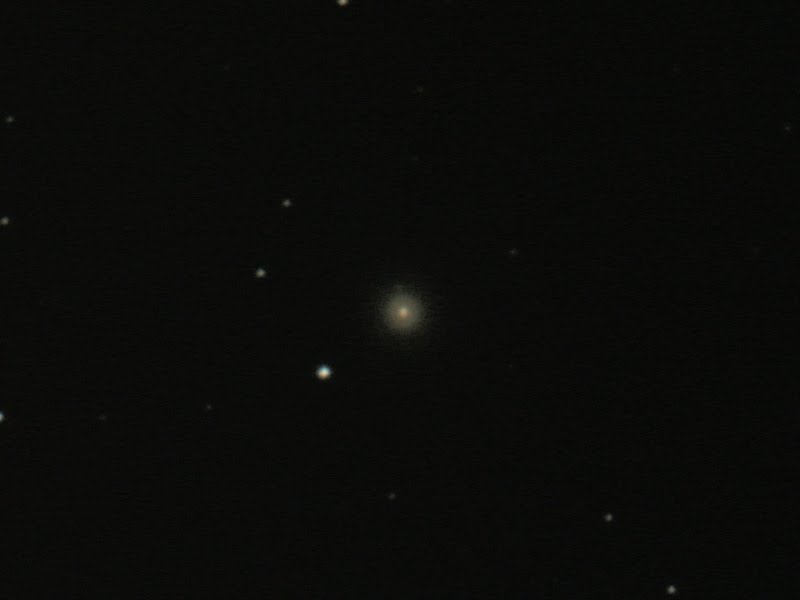 This is the last image made with the big telescope before the mirror was taken for an emergency realuminisation. It's a wierd 'little' galaxy 72 million l.y. away in Pegasus, with a bright yellow nucleus and a detached blue ring surrounding it. There is a larger halo, that doesn't really show up in this image, comprising of 31 only 12 second images at f/3. I was having issues with the tracking so I had to keep the pics short, but on closer inspection, each image still had slight star trails or a touch azimuthal shake or wobble. You can see the colour of the nucleus compared with the star nearby. It's about a 7' x 9' field centred on NGC 7742.
Subscribe to:
Comments (Atom)
