
Monday, 25 September 2017
The Spring Gegenschein
We host a Star Party in East England at a Dark Sky Discovery Site close to RSPB Minsmere. The sky has reached an SQM level of 21.75 magnitudes per square arcsecond there, and it is dark enough to see the Zodiacal light after sunset in spring. There still is some light pollution, but much less than most places and it is really a very impressive site. What's more the company is great - it is a gathering of like-minded astronomers from semi-local societies. After having seen the Zodiacal light there in 2016, and again (but slightly less clearly) in 2017, I thought I'd have a go at taking lots of exposure on the patch of sky where the 'counterglow' or 'gegenschein' lies. The Zodiacal light is a line of scattered solar light, that follows the ecliptic plane (in which we're embedded) - so in spring you can see it passing by the Pleiades. There is also another scattering phenomenon caused by the dust that lies in this plane. It is called 'backscatter'. I was trying to see it with my naked eye and couldn't be sure, but there was always a hint of a patch of light in Virgo, near Jupiter. There was still too much background sky light to be sure, caused by distant light pollution scattering off atmospheric moisture droplets and thin cirrus clouds. After gathering about an hour's worth of snaps on both nights I was there, the cirrus closed in on the second night (which was clearer, darker & drier) and I thought I'd have a good chance of processing the data to show it. Sure enough after a straight gradient removal of light pollution, there was a blob at the expected position along the ecliptic. It didn't quite correspond to the position and shape I (thought I) saw it with my eyes, but it was very close and ~ 80% overlapping. It could be, the stars or Jupiter interfered with my visual perception. The standard kit lens 18-55mm did really well here at f/3.5 and 18mm, with 5 minute sub-exposures. 18 in total were useable, or 90 minutes. Here is the result. You can see the processed-out cloud at the bottom right, due to Virgo sinking. Try to pick out the constellations!


Sunday, 24 September 2017
Early Autumn Skies
In Early Autumn, you can catch a nice glimpse of the Milky Way in dark skies, rising from the SSW, where we look into the centre of the galaxy. Unfortunately it is very low down so we look through a lot of interfering atmosphere and consequently light pollution (produced by either ignorant, paranoid, or uncaring folk that install inappropriate outdoor lights). Despite this impedance, the power of long exposures, stacking and a lens that runs at f/2 (stopped to f/2.2 in an attempt to cut down abberrations) can be used to produce a good image. Cloud, twilight and mist were threatening to spoil my attempt but the moon was out of the way at last! There is so little time for astronomers to get good viewing conditions we have to seize opportunities like this. I have stacked 7 x 1 minute images taken at ISO 800 tracked with an RA motor, with my modified Canon 1000D, with a 100mm prime f/2 lens from a quiet, dark site south of Norwich. The region is North Sagittarius/Scutum and it contains M24 - the sagittarius star cloud, M17 the swan nebula, M16 the eagle nebula, and numerous other nebulae and clusters.


Another shot at the I.S.S.
Apologies for being away for a year and a half! The gaps between my blog posts have been growing wider and wider. In the meantime I've been running an astronomy society. I thought my first post back would be to see if this year's attempt at catching the ISS is any better than the Feb 2016 one. Same tech, ZWO ASI 130MC camera at f/10 on 8" SCT manually driven. It is very hard to follow the thing at the best of times, but the camera also has the problem of a rolling shutter, which makes it really unsuitable to capturing fast moving objects. This is especially true for stacking purposes. I therefore corrected the best 10 shots, by de-skewing them, and making sure they were taken within a few seconds of each other. July 27th 2017 pass over UK.


Saturday, 13 February 2016
Attempts at imaging an object at 17100mph
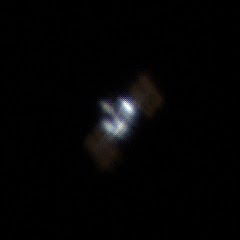
Here are my ISS images through my 8" SCT. The first was taken on January 17th at about 5:30 am. It was spooky watching for it as the shadowed station appeared on live view on the Heaven's above app on my phone. It appeared exactly on cue and I grabbed my telescope ready to move it by hand. I started recording and looked down the finder scope. I tried my best to position the scope so the bright spot exactly crossed the crosshairs. On looking at the video, however the shutter speed had been so fast (1/1500") it had skewed the image. For the second attempt, on the evening of February the 10th, I used 3ms (1/300"), and perhaps this was too slow as there was some blurring. It is a learning process, so next time I'll aim half way between and set the gain a little higher. The solar panels were pointing toward the sun and so were lit only faintly by the reflected light glancing off the earth, but they look brownish in the second image. The illumination angle was pointed out to me by Mike H from our society.

Friday, 9 October 2015
Obligatory moon shot!
After a warm and cosy hour's sleep, I forced myself to get out of bed to catch this rare occurrence. I think UK has been a bit unlucky with lunar eclipses recently. America seems to have got them all. The clouds cleared for me, but friends just down the road had a different story. I composited 6 shots through my 8" SCT to get this one, plus co-added and blended in a non-saturated moon. I tweaked the saturation and sharpened a little. Beautiful sharp stars with this technique!


Thursday, 8 October 2015
Kielder Water
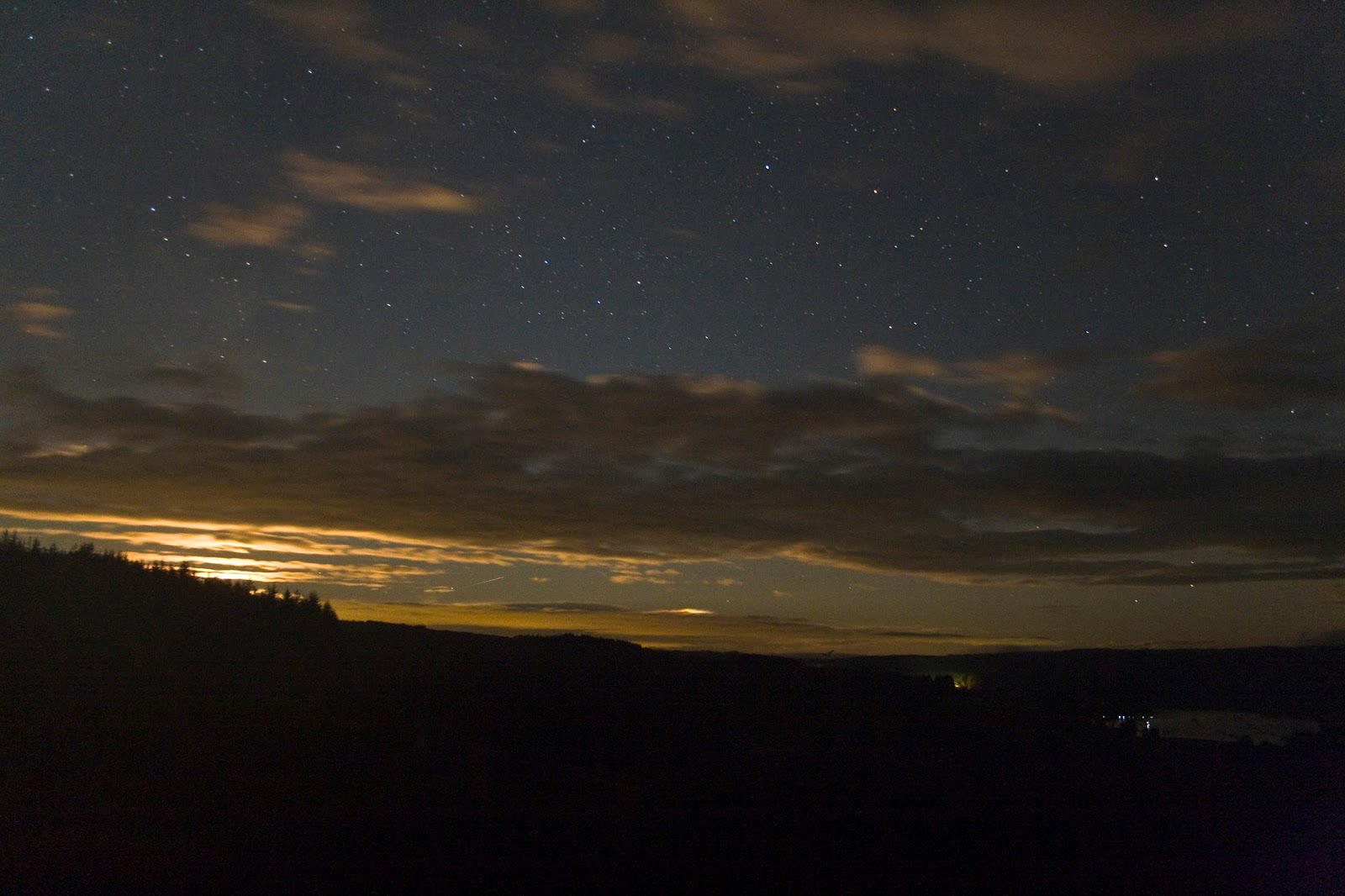
We went on a drive up the spine of the UK to Kielder Water - and took advantage of the dark sky park status. These are some pictures we took on Monday night. It was pretty dark up there, but the cloud was rolling in. We stopped at a view point off the South side and got some simple long exposures of different lengths and focal lengths on the Canon 1000D with just a tripod as the moon was setting. I've processed a little in photoshop/paintshop. Spot the 'moon-dog'. The milky way shots didn't come out well as the lens misted up very quickly! The observatory at the top of the hill at the far end was a very welcoming and fantastic little place. It's an innovative design - almost like a jetty with two fairly roomy observatory domes along it's deck.




Sunday, 23 August 2015
Scouting around for good astronomy sites


Saturday, 11 July 2015
The Lagoon Nebula

Sunday, 14 June 2015
Saturn heading South

Wednesday, 27 May 2015
Norwich by Night 2015
With a bit of stacking and processing, Norwich is beginning to look like some sort of dark rural location. I'm lucky to live on a street where the lights are switched off at 1am BST. The sky was quite light really but the sky has been stacked and processed separately from the houses. "Norwich by Night 2015 has been spoiled by some cloud streaming in and the dust bunny to the right of the centre, but for me it's quite amazing to see the milky way from a city. Only the Scutum-Aquila cloud (upper left)was visible to the naked eye through the window, but the rest of the detail was brought out with contrast enhancing. I particularly like how I caught a faint reflection of my face peering over the roof corner at the centre, just to the right of the Lagoon Nebula.


A librated, saturated moon
The "top right" bit of the moon on April 26th with the colour saturation enhanced by 500%. Maximum libration point was just beyond the 'sea' near the top centre, which means we can see slightly round the edge of the usual face of the moon. The 'sea' is Mare Humboldtianum. The moon seems to be muddy brown and electric blue, when you turn the colour up.


Fleeting Mercury
Mercury above the rooftops at 21:56 BST 13th May. Snapped by poking my telephoto lens out of my bathroom window. ISO1600 f/5 1/15". It's always very low in the twilight, following the sun down, and it's only visible for brief windows of time, if it's clear. An elusive, vespertine planet! The camera lens's resolution isn't enough to resolve the shape of the planet but I've included a 5x inset.


A conjunction and strange things flying above my head
The night of April 11 was a nice little trip to the observatory, watching Venus and the Pleiades setting over the dome. I settled on this picture, which makes the dome loom large like St Pauls Cathedral, rather than the close up on the conjunction, which showed the gibbous phase of Venus. I also managed to spot the International Space Station beginning a flyover, so I repositioned the tripod and my head hoping to capture it flying past. Previous experience has allowed me to judge where to position myself but keeping still for 30 seconds is not easy. It's a lovely composition of cloud, space station flying through Lynx, Leo, Jupiter and Praesepe - the Beehive cluster and Pollux and Castor just above the dome.


Sunday, 17 May 2015
Io and Europa's close encounter
Here's an example of where reality can get close to the simulation. I got some good seeing, and with a decent camera (a ZWO ASI) I got a decent video-capture of Jupiter's moons Io and Europa through my 8" SCT from a city backyard, as they passed by each other, at one point just overlapping. The image is in two parts, and explains itself. The angles are a bit different.


Zodiacal Light from Equinox Star Camp
Yeah! There are still parts of England that have escaped enough the scourge of light pollution, so that the zodiacal light can be photographed. I took this panorama on the equinox (March 21st 2015) from Haw Wood Farm campsite in Suffolk, near Minsmere. This is a beautiful area of the country, not too far a drive from the capital. Our astronomical society, Breckland, had a few members and guests attend a star party weekend at the campsite. I didn't however, look for the zodiacal light, I just noticed it on the photograph, once I'd stitched together this panorama. It is a series of 4 x 30 second exposures at f/3.5 on a regular Canon lens moving from South to West. The sky featured a beautiful range of objects, from left to right: Sirius, the Milky Way, Orion, the Hyades, the Pleiades, then the Crescent Moon and Venus.


Saturday, 14 February 2015
Lovejoy


The million kilometer plasma filament

A winter favourite

Monday, 26 January 2015
Jupiter's triple transit

The image above is Jupiter on the 20-inch for comparison, the following Tuesday night. There is a slight aberration in the optical system, but the moons Europa (and its shadow) and Io are very clearly shown.
Wednesday, 31 December 2014
Lovejoy emerges from the South

Subscribe to:
Posts (Atom)
